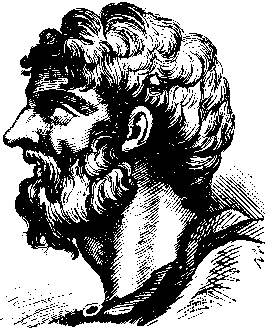
Nine lyric poets
Nine lyric poets is a group of humans.
All 3 facts, and where they come from
Facts
3 facts · 0 confirmed by two sources · 0 cited · 3 from one source
Where this comes from
Papalocal keeps its own record. It started from these sources; what each one said is kept here as it was copied, so a change on their side never changes this page by itself. Tap one to read its version.
What Wikidata says · copied November 17, 2026 · revision 2396001641
- Described as
- group of humans
- What it is
- group of humans; art movement; ennead
- Wikipedias with a page
- 28
Wikidata item Q890347 (wikidata.org/wiki/Q890347), public domain (CC0). Copied 2026-11-17.
What Wikipedia says · copied November 17, 2026 · revision 1376244483
The Nine Lyric or Melic Poets were a canonical group of ancient Greek poets esteemed by the scholars of Hellenistic Alexandria as worthy of critical study. In the Palatine Anthology it is said that they established lyric song.
They were:Alcman of Sparta (choral lyric, 7th century BC)
Sappho of Mytilene or Eresos of Lesbos (monodic lyric, 7th century BC)
Alcaeus of Mytilene of Lesbos (monodic lyric, 7th century BC)
Anacreon of Teos (monodic lyric, 6th century BC)
Stesichorus of Metauros (choral lyric, 7th century BC)
Ibycus of Rhegium (choral lyric, 6th century BC)
Simonides of Ceos (choral lyric, 6th century BC)
Bacchylides of Ceos (choral lyric, 5th century BC)
Pindar of Thebes (choral lyric, 5th century BC)
In most Greek sources the word melikos (from melos, "song") is used to refer to these poets, but the variant lyrikos (from lyra, "lyre") became the regular form in both Latin (as lyricus) and in modern languages. The ancient scholars defined the genre on the basis of the musical accompaniment, not the content. Thus, some types of poetry which would be included under the label "lyric poetry" in modern criticism, are excluded—namely, the elegy and iambus which were performed with flutes.
The Nine Lyric Poets are traditionally divided among those who primarily composed choral verses, and those who composed monodic verses. This division is contested by some modern scholars.
Antipater of Thessalonica proposes an alternative canon of nine female poets, which are: Praxilla, Moero, Anyte, Sappho, Erinna, Telesilla, Corinna, Nossis, and Myrtis.
From the Wikipedia article “Nine Lyric Poets” (en.wikipedia.org/wiki/Nine_Lyric_Poets), by its contributors, under CC BY-SA 4.0 (creativecommons.org/licenses/by-sa/4.0/). Copied 2026-11-17; not changed.
Confirmed Two sources agree. Cited One source, and it names where it got it. One source One source, without a reference of its own. Sources disagree The sources disagree. We show the best-supported value and keep theirs below.