Noether's theorem
Noether's theorem is a physical law that differentiable symmetries correspond to conservation laws.
All 3 facts, and where they come from
Facts
3 facts · 0 confirmed by two sources · 0 cited · 3 from one source
Where this comes from
Papalocal keeps its own record. It started from these sources; what each one said is kept here as it was copied, so a change on their side never changes this page by itself. Tap one to read its version.
What Wikidata says · copied November 17, 2026 · revision 2563172964
- Described as
- physical law that differentiable symmetries correspond to conservation laws
- Other names
- Noether's first theorem
- What it is
- theorem
- Followed by
- Noether's second theorem
- Named after
- Emmy Noether
- Wikipedias with a page
- 38
Wikidata item Q578555 (wikidata.org/wiki/Q578555), public domain (CC0). Copied 2026-11-17.
What Wikipedia says · copied November 17, 2026 · revision 1382508684
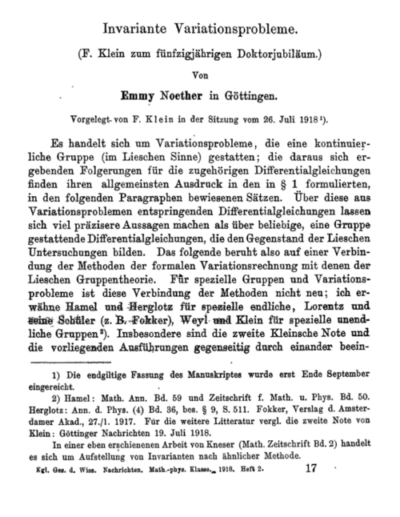
Noether's theorem states that every continuous symmetry of the action of a physical system with conservative forces has a corresponding conservation law. This is the first of two theorems (see Noether's second theorem) published by the mathematician Emmy Noether in 1918. The action of a physical system is the integral over time of a Lagrangian function, from which the system's behavior can be determined by the principle of least action. This theorem applies to continuous and smooth symmetries of physical space. Noether's formulation is quite general and has been applied across classical mechanics, high energy physics, and recently statistical mechanics.
Noether's theorem is used in theoretical physics and the calculus of variations. It reveals the fundamental relation between the symmetries of a physical system and the conservation laws. It also made modern theoretical physicists much more focused on symmetries of physical systems. A generalization of the formulations on constants of motion in Lagrangian and Hamiltonian mechanics (developed in 1788 and 1833, respectively), it does not apply to systems that cannot be modeled with a Lagrangian alone (e.g., systems with a Rayleigh dissipation function). In particular, dissipative systems with continuous symmetries need not have a corresponding conservation law.
From the Wikipedia article “Noether's theorem” (en.wikipedia.org/wiki/Noether's_theorem), by its contributors, under CC BY-SA 4.0 (creativecommons.org/licenses/by-sa/4.0/). Copied 2026-11-17; not changed.
Confirmed Two sources agree. Cited One source, and it names where it got it. One source One source, without a reference of its own. Sources disagree The sources disagree. We show the best-supported value and keep theirs below.
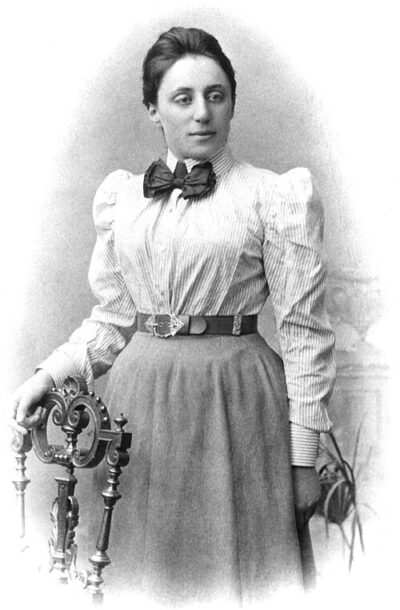
Picture: Emmy Noether, via Wikimedia Commons · Public domain