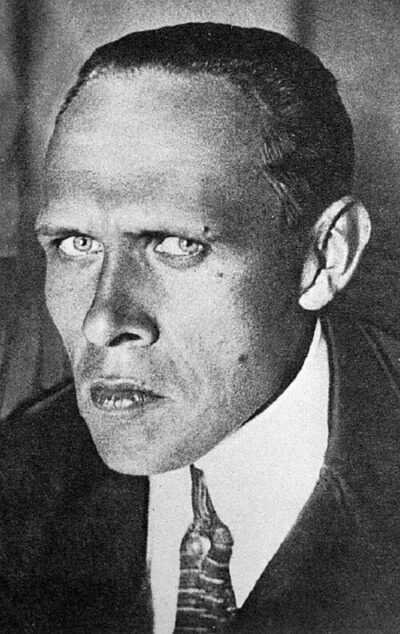
OBERIU
OBERIU is an avant-garde collective. It was founded in 1927 by Daniil Kharms. Its headquarters are in Saint Petersburg.
- Founded
- 1927
- Founded by
- Daniil Kharms
- Headquarters
- Saint Petersburg
All 5 facts, and where they come from
Facts
5 facts · 0 confirmed by two sources · 0 cited · 5 from one source
Where this comes from
Papalocal keeps its own record. It started from these sources; what each one said is kept here as it was copied, so a change on their side never changes this page by itself. Tap one to read its version.
What Wikidata says · copied November 17, 2026 · revision 2558189526
- Described as
- avant-garde collective
- What it is
- literary society
- Founded
- 1927
- Ended
- 1930
- Founded by
- Daniil Kharms
- Headquarters
- Saint Petersburg
- Wikipedias with a page
- 10
Wikidata item Q1779590 (wikidata.org/wiki/Q1779590), public domain (CC0). Copied 2026-11-17.
What Wikipedia says · copied November 17, 2026 · revision 1297543041
OBERIU (Russian: ОБЭРИУ - Объединение реального искусства; English: the Union of Real Art or the Association for Real Art) was a short-lived avant-garde collective of Russian Futurist writers, musicians, and artists in the 1920s and 1930s. The group coalesced in the context of the "intense centralization of Soviet Culture" and the decline of the avant garde culture of Leningrad, as "leftist" groups were becoming increasingly marginalized.
Founded in 1927 by Daniil Kharms and Alexander Vvedensky, OBERIU became notorious for provocative performances which included circus-like stunts, readings of what was perceived as nonsensical verse, and theatrical presentations, such as Kharms's Elizabeth Bam, that foreshadowed the European Theatre of the Absurd. The presentations took place in venues ranging from theaters and university auditoriums to dormitories and prisons. The group's actions were derided as "literary hooliganism" in the ever-more conservative press of the late 1920s. It was chastised even more in the early 1930s, and many of its associates were arrested. The OBERIU has often been called "the last Soviet avant-garde."
From the Wikipedia article “Oberiu” (en.wikipedia.org/wiki/Oberiu), by its contributors, under CC BY-SA 4.0 (creativecommons.org/licenses/by-sa/4.0/). Copied 2026-11-17; not changed.
Confirmed Two sources agree. Cited One source, and it names where it got it. One source One source, without a reference of its own. Sources disagree The sources disagree. We show the best-supported value and keep theirs below.