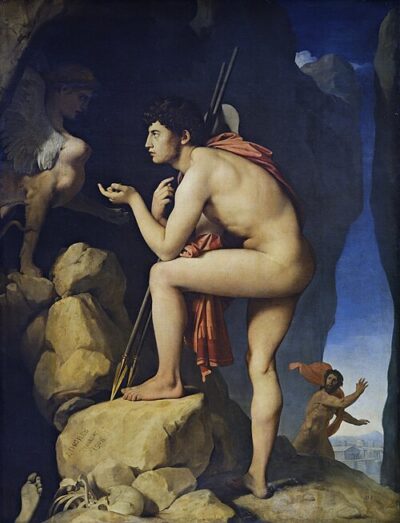
Oedipus and the Sphinx
Oedipus and the Sphinx is a painting by Jean-Auguste-Dominique Ingres in the Louvre. It came out in 1808.
- Came out
- 1808
- Created by
- Jean-Auguste-Dominique Ingres
- Genre
- mythological painting
All 7 facts, and where they come from
Facts
7 facts · 0 confirmed by two sources · 1 cited · 6 from one source
Where this comes from
Papalocal keeps its own record. It started from these sources; what each one said is kept here as it was copied, so a change on their side never changes this page by itself. Tap one to read its version.
What Wikidata says · copied November 17, 2026 · revision 2564330424
- Described as
- painting by Jean-Auguste-Dominique Ingres in the Louvre
- Other names
- Oedipus Explaining the Enigma of the Sphinx
- What it is
- painting; envoi de Rome
- Created by
- Jean-Auguste-Dominique Ingres · 1 reference
- Genre
- mythological painting; nude
- Came out
- 1808
- Owned by
- French State · 1 reference
- Wikipedias with a page
- 15
Wikidata item Q5818528 (wikidata.org/wiki/Q5818528), public domain (CC0). Copied 2026-11-17.
What Wikipedia says · copied November 17, 2026 · revision 1361315625
Oedipus and the Sphinx is a painting by the French Neoclassical artist Jean-Auguste-Dominique Ingres. Originally a student work painted in 1808, it was enlarged and completed in 1827. The painting depicts Oedipus explaining the riddle of the Sphinx. An oil painting on canvas, it measures 189 x 144 cm, and is in the Louvre, which acquired it in 1878.
From the Wikipedia article “Oedipus and the Sphinx (Ingres)” (en.wikipedia.org/wiki/Oedipus_and_the_Sphinx_(Ingres)), by its contributors, under CC BY-SA 4.0 (creativecommons.org/licenses/by-sa/4.0/). Copied 2026-11-17; not changed.
Confirmed Two sources agree. Cited One source, and it names where it got it. One source One source, without a reference of its own. Sources disagree The sources disagree. We show the best-supported value and keep theirs below.
Picture: Jean-Auguste-Dominique Ingres, via Wikimedia Commons · Public domain