Oedipus at Colonus
Oedipus at Colonus is an ancient Greek tragedy by Sophocles.
- Written by
- Sophocles
- Genre
- Greek tragedy
All 4 facts, and where they come from
Facts
4 facts · 0 confirmed by two sources · 2 cited · 2 from one source
Where this comes from
Papalocal keeps its own record. It started from these sources; what each one said is kept here as it was copied, so a change on their side never changes this page by itself. Tap one to read its version.
What Wikidata says · copied November 17, 2026 · revision 2565891426
- Described as
- ancient Greek tragedy by Sophocles
- Other names
- Oidipous at Colonos, Oedipus at Colonna, Oedipus on Kolonos, Oedipus at colonus, OEdipe a Colone, Œdipus Coloneus, Soph. OC, Oedipus at Colonos
- What it is
- dramatic work
- Written by
- Sophocles · 1 reference
- Genre
- Greek tragedy
- Language
- Ancient Greek · 1 reference
- Wikipedias with a page
- 42
Wikidata item Q294001 (wikidata.org/wiki/Q294001), public domain (CC0). Copied 2026-11-17.
What Wikipedia says · copied November 17, 2026 · revision 1367469860
Oedipus at Colonus (also Oedipus Coloneus; Ancient Greek: Οἰδίπους ἐπὶ Κολωνῷ, Oidipous epi Kolōnō) is the second of the three Theban plays of the Athenian tragedian Sophocles. It was written shortly before Sophocles's death in 406 BC and produced by his grandson (also called Sophocles) at the Festival of Dionysus in 401 BC.
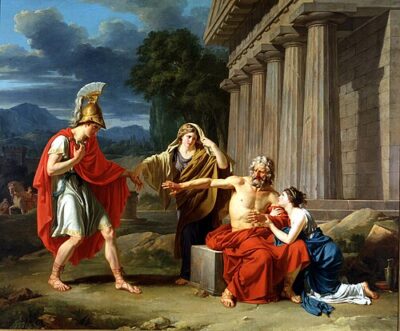
In the timeline of the plays, the events of Oedipus at Colonus occur after Oedipus Rex and before Antigone; however, it was the last of Sophocles's three Theban plays to be written. The play describes the end of Oedipus's tragic life. Legends differ as to the site of Oedipus's death; Sophocles set the place at Colonus, a village near Athens and also Sophocles's own birthplace, where the blinded Oedipus has come with his daughters Antigone and Ismene as suppliants of the Erinyes and of Theseus, the king of Athens.
From the Wikipedia article “Oedipus at Colonus” (en.wikipedia.org/wiki/Oedipus_at_Colonus), by its contributors, under CC BY-SA 4.0 (creativecommons.org/licenses/by-sa/4.0/). Copied 2026-11-17; not changed.
Confirmed Two sources agree. Cited One source, and it names where it got it. One source One source, without a reference of its own. Sources disagree The sources disagree. We show the best-supported value and keep theirs below.
Picture: Jean-Antoine-Théodore Giroust, via Wikimedia Commons · Public domain