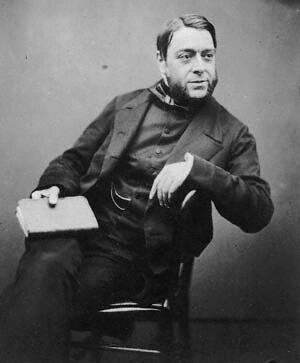
Omphalos
Omphalos is a book by Philip Henry Gosse. It came out in 1857.
- Published
- 1857
- Written by
- Philip Henry Gosse
All 3 facts, and where they come from
Facts
3 facts · 0 confirmed by two sources · 0 cited · 3 from one source
Where this comes from
Papalocal keeps its own record. It started from these sources; what each one said is kept here as it was copied, so a change on their side never changes this page by itself. Tap one to read its version.
What Wikidata says · copied November 18, 2026 · revision 1779557494
- Described as
- book by Philip Henry Gosse
- What it is
- literary work
- Written by
- Philip Henry Gosse
- Published
- 1857
- Wikipedias with a page
- 1
Wikidata item Q7090719 (wikidata.org/wiki/Q7090719), public domain (CC0). Copied 2026-11-18.
What Wikipedia says · copied November 18, 2026 · revision 1292735628
Omphalos: An Attempt to Untie the Geological Knot is a book by Philip Gosse, written in 1857 (two years before Darwin's On the Origin of Species), in which he argues that the fossil record is not evidence of evolution, but rather that it is an act of creation inevitably made so that the world would appear to be older than it is. The reasoning parallels the reasoning that Gosse chose to explain why Adam (who would have had no mother) had a navel: Though Adam would have had no need of a navel, God gave him one anyway to give him the appearance of having a human ancestry. Thus, the name of the book, Omphalos, which means 'navel' in Greek.
Darwin is mentioned several times within the book, but always with considerable respect. Gosse had attended meetings at the Royal Society where evolutionary theory was tested by Darwin before the publication of Origin—and had even made similar observations himself about variation of species in his own studies into marine biology—and considered Darwin's reasoning scientifically sound.
From the Wikipedia article “Omphalos (book)” (en.wikipedia.org/wiki/Omphalos_(book)), by its contributors, under CC BY-SA 4.0 (creativecommons.org/licenses/by-sa/4.0/). Copied 2026-11-18; not changed.
Confirmed Two sources agree. Cited One source, and it names where it got it. One source One source, without a reference of its own. Sources disagree The sources disagree. We show the best-supported value and keep theirs below.