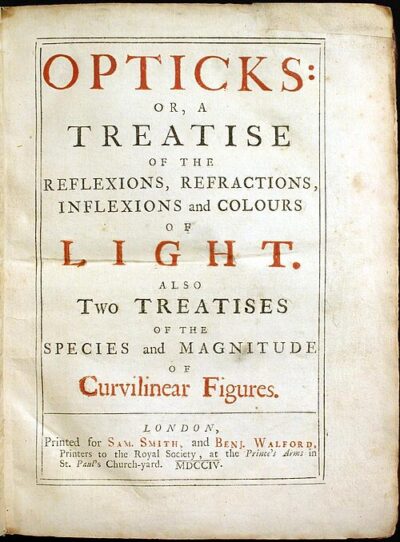
Opticks, or a Treatise of the Reflections, Refractions, Inflections and Colours of Light
Opticks, or a Treatise of the Reflections, Refractions, Inflections and Colours of Light is a work by Isaac Newton. It came out in 1704.
- Published
- 1704
- Written by
- Isaac Newton
- Genre
- scientific literature
- Country of origin
- Kingdom of England
All 6 facts, and where they come from
Facts
6 facts · 0 confirmed by two sources · 2 cited · 4 from one source
Where this comes from
Papalocal keeps its own record. It started from these sources; what each one said is kept here as it was copied, so a change on their side never changes this page by itself. Tap one to read its version.
What Wikidata says · copied November 17, 2026 · revision 2550084462
- Described as
- work by Isaac Newton
- What it is
- written work
- Written by
- Isaac Newton · 1 reference
- Genre
- scientific literature
- Published
- 1704 · 1 reference
- Language
- English
- Country of origin
- Kingdom of England
- Wikipedias with a page
- 34
Wikidata item Q74263 (wikidata.org/wiki/Q74263), public domain (CC0). Copied 2026-11-17.
What Wikipedia says · copied November 17, 2026 · revision 1384230160
Opticks: or, A Treatise of the Reflexions, Refractions, Inflexions and Colours of Light is a collection of three books by Isaac Newton that was published in English in 1704 (a scholarly Latin translation appeared in 1706). The treatise analyses the fundamental nature of light by means of the refraction of light with prisms and lenses, the diffraction of light by closely spaced sheets of glass, and the behaviour of colour mixtures with spectral lights or pigment powders. Opticks was Newton's second major work on physical science and it is considered one of the three major works on optics during the Scientific Revolution (alongside Johannes Kepler's Astronomiae Pars Optica and Christiaan Huygens' Treatise on Light).
From the Wikipedia article “Opticks” (en.wikipedia.org/wiki/Opticks), by its contributors, under CC BY-SA 4.0 (creativecommons.org/licenses/by-sa/4.0/). Copied 2026-11-17; not changed.
Confirmed Two sources agree. Cited One source, and it names where it got it. One source One source, without a reference of its own. Sources disagree The sources disagree. We show the best-supported value and keep theirs below.
Picture: Wikimedia Commons · Public domain