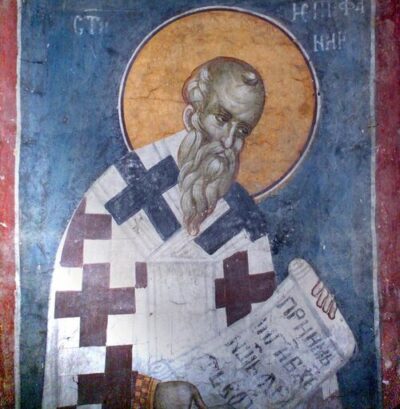
Panarion
Panarion is a book by Epiphanius of Salamis about Christian heresies.
- Written by
- Epiphanius of Salamis
All 3 facts, and where they come from
Facts
3 facts · 0 confirmed by two sources · 0 cited · 3 from one source
Where this comes from
Papalocal keeps its own record. It started from these sources; what each one said is kept here as it was copied, so a change on their side never changes this page by itself. Tap one to read its version.
What Wikidata says · copied November 17, 2026 · revision 2539186600
- Described as
- book by Epiphanius of Salamis about Christian heresies
- What it is
- written work
- Written by
- Epiphanius of Salamis
- Language
- Ancient Greek
- Wikipedias with a page
- 12
Wikidata item Q731974 (wikidata.org/wiki/Q731974), public domain (CC0). Copied 2026-11-17.
What Wikipedia says · copied November 17, 2026 · revision 1359678141
In early Christian heresiology, the Panarion (Koine Greek: Πανάριον, derived from Latin panarium, meaning "bread basket"), to which 16th-century Latin translations gave the name Adversus Haereses (Latin: "Against Heresies"), is the most important of the works of Epiphanius of Salamis. It was written in Koine Greek beginning in AD 374 or 375, and issued about three years later, as a treatise on heresies, with its title referring to the text as a "stock of remedies to offset the poisons of heresy." It treats 80 religious sects, either organized groups or philosophies, from the time of Adam to the latter part of the fourth century, detailing their histories, and rebutting their beliefs. The Panarion is an important source of information on the Jewish–Christian gospels, the Gospel of the Ebionites, and the Gospel of the Hebrews.
The treatise can be considered a sequel to the Ancoratus (374), which takes the form of a letter to the church of Syedra in Pamphylia, describing how the "barque" of the church can counteract the contrary winds of heretical thought, and become "anchored" (ἀγχυρωτός); hence the title of the work; the Ancoratus even outlines the content of the Panarion within its text.
From the Wikipedia article “Panarion” (en.wikipedia.org/wiki/Panarion), by its contributors, under CC BY-SA 4.0 (creativecommons.org/licenses/by-sa/4.0/). Copied 2026-11-17; not changed.
Confirmed Two sources agree. Cited One source, and it names where it got it. One source One source, without a reference of its own. Sources disagree The sources disagree. We show the best-supported value and keep theirs below.
Picture: Wikimedia Commons: Панарион 1544.PNG · See Commons file page