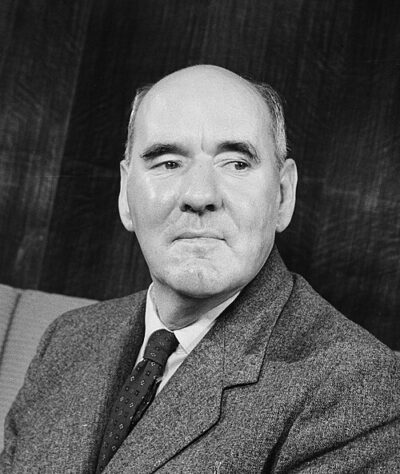
Parkinson's law
Parkinson's law is an adage that work expands to fill the time available. It was written by C. Northcote Parkinson.
- Written by
- C. Northcote Parkinson
- Genre
- essay
All 7 facts, and where they come from
Facts
7 facts · 0 confirmed by two sources · 0 cited · 7 from one source
Where this comes from
Papalocal keeps its own record. It started from these sources; what each one said is kept here as it was copied, so a change on their side never changes this page by itself. Tap one to read its version.
What Wikidata says · copied November 17, 2026 · revision 2510971941
- Described as
- adage that work expands to fill the time available
- Other names
- Parkinson’s law
- What it is
- adage; rule; literary work
- Written by
- C. Northcote Parkinson
- Genre
- essay
- Language
- English · 1 reference
- Named after
- C. Northcote Parkinson
- Wikipedias with a page
- 36
Wikidata item Q506207 (wikidata.org/wiki/Q506207), public domain (CC0). Copied 2026-11-17.
What Wikipedia says · copied November 17, 2026 · revision 1384370022
Parkinson's Law is the title of a satirical essay by the naval historian C. Northcote Parkinson which was published in The Economist in 1955, following the report of the Royal Commission on the Civil Service. Its notable findings were that:
Work expands so as to fill the time available for its completion.
The number of workers within public administration tends to grow, regardless of the amount of work to be done.
The essay starts by giving the first finding as a "commonplace observation" while the bulk of the essay discusses the second, which Parkinson detailed as due to "The Law of Multiplication of Subordinates" and "The Law of Multiplication of Work".
The first finding has been called the personal version of the law and the second, which is not stated explicitly, the organizational version. It is the first sense which is now most commonly called Parkinson's Law. Despite their facetious origins, these findings have been widely adopted in management science and social psychology.
The essay was developed into a book, Parkinson's Law or The Pursuit of Progress, which was first published in the United States by Houghton Mifflin Company (Boston) in 1957 and then in Britain by John Murray in 1958. This explored other dysfunctions of bureaucracies and committees such as the law of triviality – "The time spent on any item of the agenda will be in inverse proportion to the sum involved" – which is now known as "bike-shedding" after the book's case study of a committee considering a nuclear reactor and then its bike shed.
From the Wikipedia article “Parkinson's Law” (en.wikipedia.org/wiki/Parkinson's_Law), by its contributors, under CC BY-SA 4.0 (creativecommons.org/licenses/by-sa/4.0/). Copied 2026-11-17; not changed.
Confirmed Two sources agree. Cited One source, and it names where it got it. One source One source, without a reference of its own. Sources disagree The sources disagree. We show the best-supported value and keep theirs below.