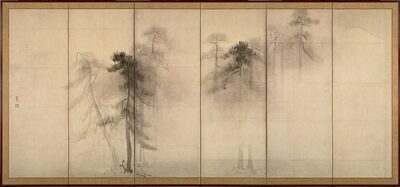
Pine Trees
Pine Trees is a couple of folding screens by Hasegawa Tōhaku. It came out in 1580.
- Came out
- 1580
- Created by
- Hasegawa Tōhaku
- Genre
- ink wash painting
- Country of origin
- Japan
All 11 facts, and where they come from
Facts
11 facts · 0 confirmed by two sources · 4 cited · 6 from one source · 1 where the sources disagree
What’s different
- Came out: we show 1580 (Sources disagree). Wikidata also lists 16th century
Where this comes from
Papalocal keeps its own record. It started from these sources; what each one said is kept here as it was copied, so a change on their side never changes this page by itself. Tap one to read its version.
What Wikidata says · copied November 18, 2026 · revision 2564856860
- Described as
- couple of folding screens by Hasegawa Tōhaku
- Other names
- Shōrin-zu byōbu, Pine Forest, Pine Trees screen, Pine Trees (Pine Forest)
- What it is
- byōbu; cycle of paintings; painting
- Created by
- Hasegawa Tōhaku · 1 reference
- Genre
- ink wash painting; byōbu-e
- Country of origin
- Japan · 2 references
- Came out
- 16th century; 1580 · 2 references
- Located in
- Taitō-ku · 1 reference
- Country
- Japan
- Owned by
- National Institutes for Cultural Heritage · 1 reference
- Wikipedias with a page
- 11
Wikidata item Q11531476 (wikidata.org/wiki/Q11531476), public domain (CC0). Copied 2026-11-18.
What Wikipedia says · copied November 18, 2026 · revision 1382631997
The Pine Trees screen (松林図 屏風, Shōrin-zu byōbu) is a pair of six-panel folding screens (byōbu) by the Japanese artist Hasegawa Tōhaku (長谷川 等伯), founder of the Hasegawa school of Japanese art. The precise date for the screens is not known, but they were clearly made in the late 16th century, in the Momoyama period, around 1595. The screens are held by the Tokyo National Museum, and were designated as a National Treasure of Japan in 1952.
The ink-on-paper work depicts a view of Japanese pine trees in the mist, with parts of the trees visible and parts obscured, illustrating the Zen Buddhist concept of ma (間) and evoking the Japanese wabi (侘) aesthetic of rustic simplicity. They are said to be the first paintings of their scale to depict only trees as subject matter, although a white shape to the upper right of the left panel might suggest a background mountain peak. Each screen measures 156.8 by 356 centimetres (61.7 in × 140.2 in).
From the Wikipedia article “Shōrin-zu byōbu” (en.wikipedia.org/wiki/Shōrin-zu_byōbu), by its contributors, under CC BY-SA 4.0 (creativecommons.org/licenses/by-sa/4.0/). Copied 2026-11-18; not changed.
Confirmed Two sources agree. Cited One source, and it names where it got it. One source One source, without a reference of its own. Sources disagree The sources disagree. We show the best-supported value and keep theirs below.
Picture: Wikimedia Commons: Hasegawa Tohaku - Pine Trees (Shōrin-zu byōbu) - right hand screen.jpg · See Commons file page