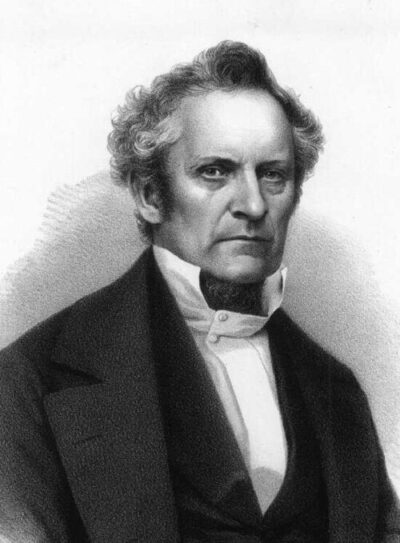
Plücker coordinates
Plücker coordinates is a method of assigning coordinates to every line in projective 3-space.
All 2 facts, and where they come from
Facts
2 facts · 0 confirmed by two sources · 0 cited · 2 from one source
Where this comes from
Papalocal keeps its own record. It started from these sources; what each one said is kept here as it was copied, so a change on their side never changes this page by itself. Tap one to read its version.
What Wikidata says · copied November 17, 2026 · revision 2498646562
- Described as
- method of assigning coordinates to every line in projective 3-space
- What it is
- mathematical concept
- Named after
- Julius Plücker
- Wikipedias with a page
- 10
Wikidata item Q2559456 (wikidata.org/wiki/Q2559456), public domain (CC0). Copied 2026-11-17.
What Wikipedia says · copied November 17, 2026 · revision 1314011462
In geometry, Plücker coordinates, introduced by Julius Plücker in the 19th century, are a way to assign six homogeneous coordinates to each line in projective 3-space, ℙ3. Because they satisfy a quadratic constraint, they establish a one-to-one correspondence between the 4-dimensional space of lines in ℙ3 and points on a quadric in ℙ5 (projective 5-space). A predecessor and special case of Grassmann coordinates (which describe k-dimensional linear subspaces, or flats, in an n-dimensional Euclidean space), Plücker coordinates arise naturally in geometric algebra. They have proved useful for computer graphics, and also can be extended to coordinates for the screws and wrenches in the theory of kinematics used for robot control.
From the Wikipedia article “Plücker coordinates” (en.wikipedia.org/wiki/Plücker_coordinates), by its contributors, under CC BY-SA 4.0 (creativecommons.org/licenses/by-sa/4.0/). Copied 2026-11-17; not changed.
Confirmed Two sources agree. Cited One source, and it names where it got it. One source One source, without a reference of its own. Sources disagree The sources disagree. We show the best-supported value and keep theirs below.