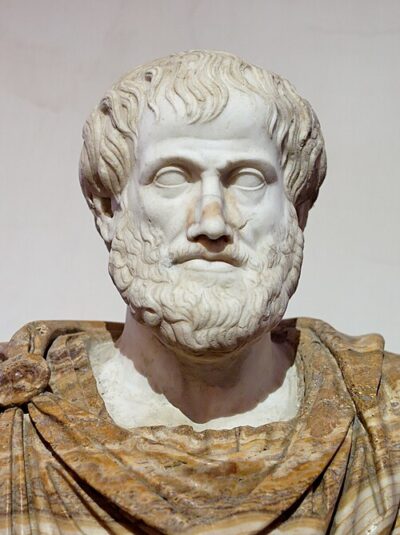
Poetics
Poetics is a book by Aristotle.
- Written by
- Aristotle
- Genre
- treatise
All 4 facts, and where they come from
Facts
4 facts · 0 confirmed by two sources · 0 cited · 4 from one source
Where this comes from
Papalocal keeps its own record. It started from these sources; what each one said is kept here as it was copied, so a change on their side never changes this page by itself. Tap one to read its version.
What Wikidata says · copied November 17, 2026 · revision 2565891161
- Described as
- book by Aristotle
- Other names
- The Poetics, Aristot. Poet.
- What it is
- written work
- Written by
- Aristotle
- Genre
- treatise
- Language
- Ancient Greek
- Wikipedias with a page
- 58
Wikidata item Q264714 (wikidata.org/wiki/Q264714), public domain (CC0). Copied 2026-11-17.
What Wikipedia says · copied November 17, 2026 · revision 1386052754
Aristotle's Poetics (Ancient Greek: Περὶ ποιητικῆς Peri poietikês; Latin: De Poetica; c. 335 BCE) is the earliest surviving work of Greek dramatic theory and the first extant philosophical treatise to solely focus on literary theory. In this text, Aristotle offers an account of ποιητική, which refers to poetry or, more literally, "the poetic art," deriving from the term for "poet, author, maker," ποιητής. Aristotle divides the art of poetry into verse, drama (comedy, tragedy, and the satyr play), lyric poetry, and epic poetry. The genres all share the function of mimesis, but differ in:
Musical rhythm, harmony, meter, and melody;
The goodness of the characters; and
The mode of storytelling.
The surviving book of Poetics is primarily concerned with drama. The analysis of tragedy constitutes the core of the discussion.
Although the text is universally acknowledged in the Western critical tradition, "every detail about this seminal work has aroused divergent opinions." A few scholarly debates on the Poetics have been most prominent: the meanings of catharsis and hamartia, the Classical unities, and whether Aristotle contradicts himself between chapters 13 and 14.
From the Wikipedia article “Poetics (Aristotle)” (en.wikipedia.org/wiki/Poetics_(Aristotle)), by its contributors, under CC BY-SA 4.0 (creativecommons.org/licenses/by-sa/4.0/). Copied 2026-11-17; not changed.
Confirmed Two sources agree. Cited One source, and it names where it got it. One source One source, without a reference of its own. Sources disagree The sources disagree. We show the best-supported value and keep theirs below.
Picture: Wikimedia Commons: Aristotle Poetica page 1.png · See Commons file page