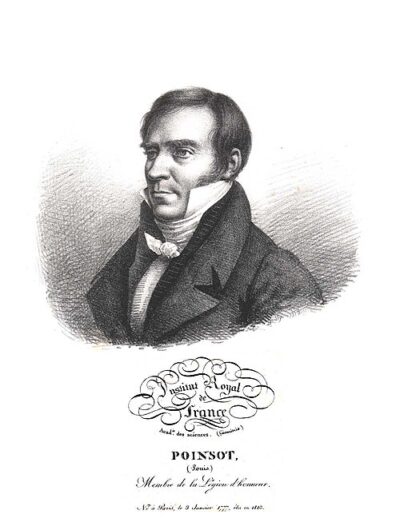
Poinsot's ellipsoid
Poinsot's ellipsoid is a geometric method for visualizing a rotating rigid body.
All 2 facts, and where they come from
Facts
2 facts · 0 confirmed by two sources · 0 cited · 2 from one source
Where this comes from
Papalocal keeps its own record. It started from these sources; what each one said is kept here as it was copied, so a change on their side never changes this page by itself. Tap one to read its version.
What Wikidata says · copied November 17, 2026 · revision 2471903814
- Described as
- geometric method for visualizing a rotating rigid body
- Other names
- Poinsot's construction
- What it is
- mathematical concept
- Named after
- Louis Poinsot
- Wikipedias with a page
- 8
Wikidata item Q1139169 (wikidata.org/wiki/Q1139169), public domain (CC0). Copied 2026-11-17.
What Wikipedia says · copied November 17, 2026 · revision 1377575904
In classical mechanics, Poinsot's construction (after Louis Poinsot) is a geometrical method for visualizing the torque-free motion of a rotating rigid body, that is, the motion of a rigid body on which no external forces are acting. This motion has four constants: the kinetic energy of the body and the three components of the angular momentum, expressed with respect to an inertial laboratory frame. The angular velocity vector 𝝎 of the rigid rotor is not constant, but satisfies Euler's equations. The conservation of kinetic energy and angular momentum provide two constraints on the motion of 𝝎.
Without explicitly solving these equations, the motion 𝝎 can be described geometrically as follows:The rigid body's motion is entirely determined by the motion of its inertia ellipsoid, which is rigidly fixed to the rigid body like a coordinate frame.
Its inertia ellipsoid rolls, without slipping, on the invariable plane, with the center of the ellipsoid a constant height above the plane.
At all times, 𝝎 is the point of contact between the ellipsoid and the plane.
The motion is quasiperiodic. 𝝎 traces out a closed curve on the ellipsoid, but a curve on the plane that is not necessarily a closed curve.The closed curve on the ellipsoid is the polhode.
The curve on the plane is the herpolhode.
If the rigid body has two equal moments of inertia (a case called a symmetric top), the line segment from the origin to 𝝎 sweeps out a cone (and its endpoint a circle). This is the torque-free precession of the rotation axis of the rotor.
From the Wikipedia article “Poinsot's ellipsoid” (en.wikipedia.org/wiki/Poinsot's_ellipsoid), by its contributors, under CC BY-SA 4.0 (creativecommons.org/licenses/by-sa/4.0/). Copied 2026-11-17; not changed.
Confirmed Two sources agree. Cited One source, and it names where it got it. One source One source, without a reference of its own. Sources disagree The sources disagree. We show the best-supported value and keep theirs below.
Picture: Wikimedia Commons: Poinsotschekonstruktion1.png · See Commons file page