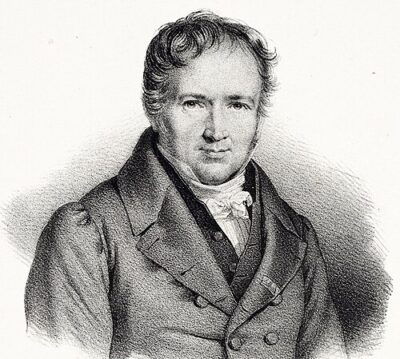
Poisson distribution
Poisson distribution is a discrete probability distribution.
All 1 facts, and where they come from
Facts
1 facts · 0 confirmed by two sources · 0 cited · 1 from one source
Where this comes from
Papalocal keeps its own record. It started from these sources; what each one said is kept here as it was copied, so a change on their side never changes this page by itself. Tap one to read its version.
What Wikidata says · copied November 17, 2026 · revision 2550439151
- Described as
- discrete probability distribution
- Other names
- law of small numbers
- Named after
- Siméon Denis Poisson
- Wikipedias with a page
- 55
Wikidata item Q205692 (wikidata.org/wiki/Q205692), public domain (CC0). Copied 2026-11-17.
What Wikipedia says · copied November 17, 2026 · revision 1383735536
In probability theory and statistics, the Poisson distribution (US: pwahss-ON, UK: PWA(H)SS-on) is a discrete probability distribution that expresses the probability of a given number of events occurring in a fixed interval of time if these events occur with a known constant mean rate and independently of the time since the last event. It can also be used for the number of events in other types of intervals than time, and in dimension greater than 1 (e.g., number of events in a given area or volume).
The Poisson distribution is named after French mathematician Siméon Denis Poisson. It plays an important role for discrete-stable distributions.
Under a Poisson distribution with the expectation of λ events in a given interval, the probability of k events in the same interval is:
λke−λk!.
For instance, consider a call center which receives an average of λ = 3 calls per minute at all times of day. If the number of calls received in any two given disjoint time intervals is independent, then the number k of calls received during any minute has a Poisson probability distribution. Receiving k = 1 to 4 calls then has a probability of about 0.77, while receiving 0 or at least 5 calls has a probability of about 0.23.
A classic example used to motivate the Poisson distribution is the number of radioactive decay events during a fixed observation period.
From the Wikipedia article “Poisson distribution” (en.wikipedia.org/wiki/Poisson_distribution), by its contributors, under CC BY-SA 4.0 (creativecommons.org/licenses/by-sa/4.0/). Copied 2026-11-17; not changed.
Confirmed Two sources agree. Cited One source, and it names where it got it. One source One source, without a reference of its own. Sources disagree The sources disagree. We show the best-supported value and keep theirs below.
Picture: Wikimedia Commons: Poisson pmf.svg · See Commons file page