Poisson's ratio
Poisson's ratio is a parameter of elastic materials: ratio of transverse strain to axial strain.
All 2 facts, and where they come from
Facts
2 facts · 0 confirmed by two sources · 0 cited · 2 from one source
Where this comes from
Papalocal keeps its own record. It started from these sources; what each one said is kept here as it was copied, so a change on their side never changes this page by itself. Tap one to read its version.
What Wikidata says · copied November 17, 2026 · revision 2527587199
- Described as
- parameter of elastic materials: ratio of transverse strain to axial strain
- Other names
- Poisson number, Poisson ratio, Poisson coefficient
- What it is
- mathematical concept
- Named after
- Siméon Denis Poisson
- Wikipedias with a page
- 58
Wikidata item Q190453 (wikidata.org/wiki/Q190453), public domain (CC0). Copied 2026-11-17.
What Wikipedia says · copied November 17, 2026 · revision 1385828684
In materials science and solid mechanics, Poisson's ratio (symbol: ν (nu)) is a measure of the Poisson effect, the deformation (expansion or contraction) of a material in directions perpendicular to the specific direction of loading. The value of Poisson's ratio is the negative of the ratio of transverse strain to axial strain. For small values of these changes, ν is the amount of transversal elongation divided by the amount of axial compression.
Most materials have Poisson's ratio values ranging between 0.0 and 0.5. For soft materials, such as rubber, where the bulk modulus is much higher than the shear modulus, Poisson's ratio is near 0.5. For open-cell polymer foams, Poisson's ratio is near zero, since the cells tend to collapse in compression. Many typical solids have Poisson's ratios in the range of 0.2 to 0.3.
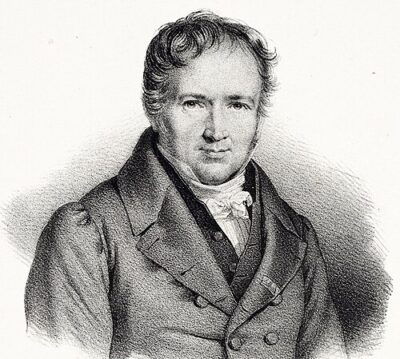
The ratio is named after the French mathematician and physicist Siméon Poisson.
From the Wikipedia article “Poisson's ratio” (en.wikipedia.org/wiki/Poisson's_ratio), by its contributors, under CC BY-SA 4.0 (creativecommons.org/licenses/by-sa/4.0/). Copied 2026-11-17; not changed.
Confirmed Two sources agree. Cited One source, and it names where it got it. One source One source, without a reference of its own. Sources disagree The sources disagree. We show the best-supported value and keep theirs below.
Picture: Wikimedia Commons: PoissonRatio.svg · See Commons file page