Politics
Politics is a work of political philosophy by Aristotle.
- Came out
- 4th century BC
- Written by
- Aristotle
- Genre
- treatise
All 5 facts, and where they come from
Facts
5 facts · 0 confirmed by two sources · 0 cited · 5 from one source
Where this comes from
Papalocal keeps its own record. It started from these sources; what each one said is kept here as it was copied, so a change on their side never changes this page by itself. Tap one to read its version.
What Wikidata says · copied November 17, 2026 · revision 2558818601
- Described as
- work of political philosophy by Aristotle
- Other names
- Aristotle's Politics, Aristot. Pol.
- What it is
- philosophical work
- Written by
- Aristotle
- Genre
- treatise
- Language
- Ancient Greek
- Came out
- 4th century BC
- Wikipedias with a page
- 50
Wikidata item Q69539 (wikidata.org/wiki/Q69539), public domain (CC0). Copied 2026-11-17.
What Wikipedia says · copied November 17, 2026 · revision 1383925180
Politics (Ancient Greek: Πολιτικά, romanized: Politiká) is a work of political philosophy by Aristotle, a 4th-century BC Greek philosopher.
At the end of the Nicomachean Ethics, Aristotle declared that the inquiry into ethics leads into a discussion of politics. The two works are frequently considered to be parts of a larger treatise – or perhaps connected lectures – dealing with the "philosophy of human affairs". In Aristotle's hierarchical system of philosophy he considers politics, the study of communities, to be of higher priority than ethics, which concerns individuals.
The title of Politics literally means "the things concerning the πόλις (polis)", and is the origin of the modern English word politics. As Aristotle explains, this is understood by him to be a study of how people should best live together in communities – the polis being seen by him as the best and most natural community for humans.
The history of Greek city-states, their wars and intrigues and political churning, was well-documented. In addition to such documentation, Aristotle pursued a research project of collecting 158 constitutions of various city-states in order to examine them for their strong and weak points. This evidence-based, descriptive approach to the study of politics was a hallmark of Aristotle's method, and a contrast with the more idealistic from-first-principles approach of Plato, as seen for example in the Republic.
As with the Nicomachean Ethics, the Politics is not a polished work as Aristotle would have written it for publication. There are various theories about the text which has come down to us. It may have been assembled from a set of shorter works on certain political themes, combined with or interlaced with his marginal notes or with the notes taken by those who attended his Lyceum lectures.
From the Wikipedia article “Politics (Aristotle)” (en.wikipedia.org/wiki/Politics_(Aristotle)), by its contributors, under CC BY-SA 4.0 (creativecommons.org/licenses/by-sa/4.0/). Copied 2026-11-17; not changed.
Confirmed Two sources agree. Cited One source, and it names where it got it. One source One source, without a reference of its own. Sources disagree The sources disagree. We show the best-supported value and keep theirs below.
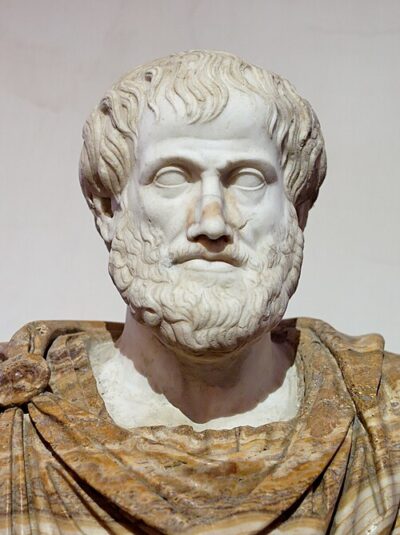
Picture: Wikimedia Commons: Greek manuscript minuscule Aristotle.png · See Commons file page