Popular Democratic Party
The Popular Democratic Party is a political party in Puerto Rico. It was founded in 1938. It stands for Status quo movement in Puerto Rico and social liberalism.
- Country
- United States
- Founded
- July 22, 1938
- Ideology
- Status quo movement in Puerto Rico
All 7 facts, and where they come from
Facts
7 facts · 0 confirmed by two sources · 0 cited · 7 from one source
Where this comes from
Papalocal keeps its own record. It started from these sources; what each one said is kept here as it was copied, so a change on their side never changes this page by itself. Tap one to read its version.
What Wikidata says · copied November 17, 2026 · revision 2517442351
- Described as
- political party in Puerto Rico
- Other names
- PPD
- What it is
- political party
- Founded
- July 22, 1938
- Headquarters
- Puerto Rico
- Country
- United States
- Ideology
- Status quo movement in Puerto Rico; social liberalism
- Official website
- http://www.ppdpr.net/
- Wikipedias with a page
- 10
Wikidata item Q199319 (wikidata.org/wiki/Q199319), public domain (CC0). Copied 2026-11-17.
What Wikipedia says · copied November 17, 2026 · revision 1380214382
The Popular Democratic Party (Spanish: Partido Popular Democrático, PPD) is a political party in Puerto Rico that advocates for the current status of the archipelago and island as an estado libre asociado (commonwealth), an unincorporated territory of the United States with constitutional self-governance. The party was founded in 1938 by dissidents from the Puerto Rican Liberal Party and the Unionist Party.
As one of the long-standing parties on the island, the PPD has played a significant role in the history of Puerto Rico. In the early 1950s, for example, the party held a majority in the delegation convened to draft the Constitution of Puerto Rico. Once the constitution was ratified, the document was proclaimed by the party's leader and co-founder, Luis Muñoz Marín—who, in doing so, became the first Puerto Rican governor elected by the people of Puerto Rico. Since 1952, the party has ruled all branches of the Puerto Rican government for a total of 36 years, while establishing many of the institutions that permeate Puerto Rican society today.
Today, the party is one of the two major parties in Puerto Rico with significant political strength. In the executive branch, the party's most recent governor was Alejandro García Padilla who governed the island from 2013 to 2017; while in the legislative branch, the party is the largest in both the House and the Senate, though it is short of an overall majority in both. On the Supreme Court, the party is in the minority, though the Chief Justice of the Supreme Court is from the PPD; a circumstance that allows the party to designate political appointees in the judicial branch since the chief justice is also constitutionally the chief judicial administrator. Finally, in the municipal landscape, the party holds more than half of the seats of mayors.
Ideologically, the PPD differs from the other parties active in the island. Historically, for example, the party's opponent has been the New Progressive Party (PNP in Spanish). Both parties have ruled the island unopposed for years after the Puerto Rican constitution was ratified in 1952.
Members of the party are referred to in different terms depending on their faction. In general, those affiliated to the party are commonly called populares (English: "populars") and mostly affiliate with the Democratic Party of the United States. Internally, members aligned with the delegation that drafted the constitution compose the largest faction and are referred to as 'conservatives'. A smaller 'liberal' faction is referred to as the soberanistas, and advocates for Puerto Rico to enter a compact of free association with the United States rather than remain an unincorporated territory under the United States.
From the Wikipedia article “Popular Democratic Party (Puerto Rico)” (en.wikipedia.org/wiki/Popular_Democratic_Party_(Puerto_Rico)), by its contributors, under CC BY-SA 4.0 (creativecommons.org/licenses/by-sa/4.0/). Copied 2026-11-17; not changed.
Confirmed Two sources agree. Cited One source, and it names where it got it. One source One source, without a reference of its own. Sources disagree The sources disagree. We show the best-supported value and keep theirs below.
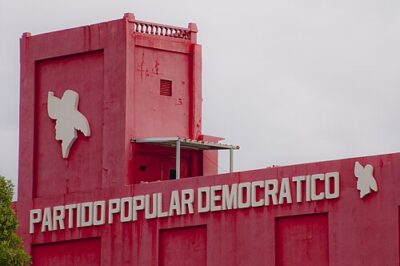
Picture: vxla, via Wikimedia Commons · CC BY 2.0