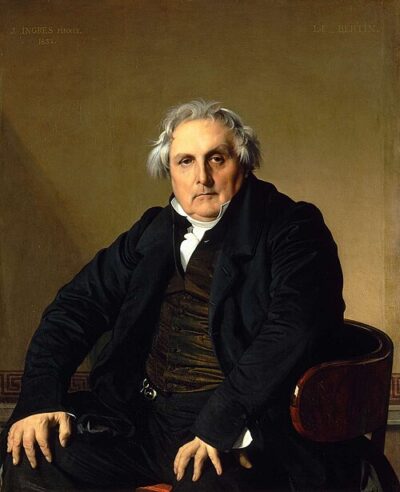
Portrait of Monsieur Bertin
Portrait of Monsieur Bertin is a painting by Jean-Auguste-Dominique Ingres. It came out in 1832.
- Came out
- 1832
- Created by
- Jean-Auguste-Dominique Ingres
- Genre
- portrait
All 5 facts, and where they come from
Facts
5 facts · 0 confirmed by two sources · 2 cited · 3 from one source
Where this comes from
Papalocal keeps its own record. It started from these sources; what each one said is kept here as it was copied, so a change on their side never changes this page by itself. Tap one to read its version.
What Wikidata says · copied November 17, 2026 · revision 2570273738
- Described as
- painting by Jean-Auguste-Dominique Ingres
- What it is
- painting · 1 reference
- Created by
- Jean-Auguste-Dominique Ingres · 1 reference
- Genre
- portrait
- Came out
- 1832
- Owned by
- French State (1897–)
- Wikipedias with a page
- 16
Wikidata item Q2985455 (wikidata.org/wiki/Q2985455), public domain (CC0). Copied 2026-11-17.
What Wikipedia says · copied November 17, 2026 · revision 1380914401
Portrait of Monsieur Bertin is an 1832 oil on canvas painting by Jean-Auguste-Dominique Ingres. It depicts Louis-François Bertin (1766–1841), the French writer, art collector and director of the pro-royalist Journal des débats. Ingres completed the portrait during his first period of success; having achieved acclaim as a history painter, he accepted portrait commissions reluctantly, viewing them as a distraction from more important work. Bertin was Ingres' friend and a politically active member of the French upper-middle class. Ingres presents him as a personification of the commercially minded leaders of the liberal reign of Louis Philippe I. He is physically imposing and self-assured, but his real-life personality shines through – warm, wry and engaging to those who had earned his trust.
The painting had a prolonged genesis. Ingres agonised over the pose during several preparatory sketches. The final work captures the sitter's character, conveying a restless energy and imposing bulk. He sits in three-quarter profile against a brown ground lit from the right; his fingers are pronounced and highly detailed, while the polish of his chair reflects light from an unseen window. It is an unflinchingly realistic depiction of ageing and emphasises the furrowed skin and thinning hair of an overweight man who yet maintains his resolve and determination.
Ingres' portrait was a critical and popular success, but the sitter was a private person. Although his family worried about caricature and disapproved, it became widely known and sealed the artist's reputation. It was praised at the Paris Salon of 1833 and influenced both academic painters such as Léon Bonnat and later modernists including Pablo Picasso and Félix Vallotton. Modern art historians regard it as Ingres' finest male portrait. It has been on permanent display at the Musée du Louvre since 1897.
From the Wikipedia article “Portrait of Monsieur Bertin” (en.wikipedia.org/wiki/Portrait_of_Monsieur_Bertin), by its contributors, under CC BY-SA 4.0 (creativecommons.org/licenses/by-sa/4.0/). Copied 2026-11-17; not changed.
Confirmed Two sources agree. Cited One source, and it names where it got it. One source One source, without a reference of its own. Sources disagree The sources disagree. We show the best-supported value and keep theirs below.
Picture: Jean-Auguste-Dominique Ingres, via Wikimedia Commons · Public domain