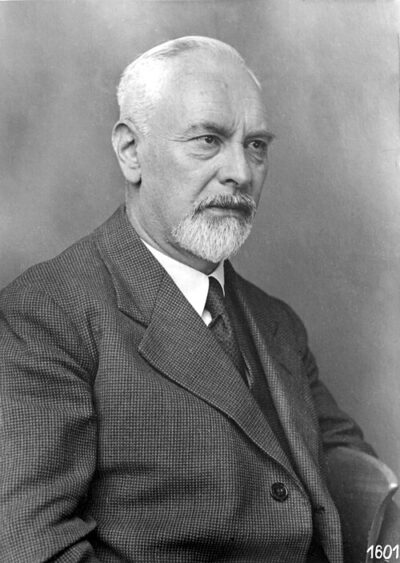
Prandtl number
Prandtl number is a quotient of kinematic viscosity and thermal diffusivity for a fluid.
All 2 facts, and where they come from
Facts
2 facts · 0 confirmed by two sources · 0 cited · 2 from one source
Where this comes from
Papalocal keeps its own record. It started from these sources; what each one said is kept here as it was copied, so a change on their side never changes this page by itself. Tap one to read its version.
What Wikidata says · copied November 17, 2026 · revision 2543265347
- Described as
- quotient of kinematic viscosity and thermal diffusivity for a fluid
- What it is
- thermodynamic material property
- Named after
- Ludwig Prandtl
- Wikipedias with a page
- 32
Wikidata item Q815306 (wikidata.org/wiki/Q815306), public domain (CC0). Copied 2026-11-17.
What Wikipedia says · copied November 17, 2026 · revision 1383300059
The Prandtl number (Pr) is a dimensionless number, named for the German fluid dynamicist Ludwig Prandtl. It is defined as the ratio of momentum diffusivity to thermal diffusivity. The Prandtl number is a ratio of physical properties that may be arranged in several ways
Pr=να=momentum diffusivitythermal diffusivity=μ/ρk/(cpρ)=cpμk
where the symbols are as follows:ν : kinematic viscosity (momentum diffusivity), ν=μ/ρ [m2/s]
α : thermal diffusivity, α=k/(ρcp) [m2/s]
μ : dynamic viscosity [Pa s = N s/m2]
k : thermal conductivity [W/(m·K)]
cp : specific heat [J/(kg·K)]
ρ : density [kg/m3].
The Prandtl number is a property of the fluid. Unlike the Reynolds number and Grashof number, it does not change with length scale or other conditions of the flow field.
The mass transfer analog of the Prandtl number is the Schmidt number. The ratio of the Schmidt number to the Prandtl number is called the Lewis number.
From the Wikipedia article “Prandtl number” (en.wikipedia.org/wiki/Prandtl_number), by its contributors, under CC BY-SA 4.0 (creativecommons.org/licenses/by-sa/4.0/). Copied 2026-11-17; not changed.
Confirmed Two sources agree. Cited One source, and it names where it got it. One source One source, without a reference of its own. Sources disagree The sources disagree. We show the best-supported value and keep theirs below.