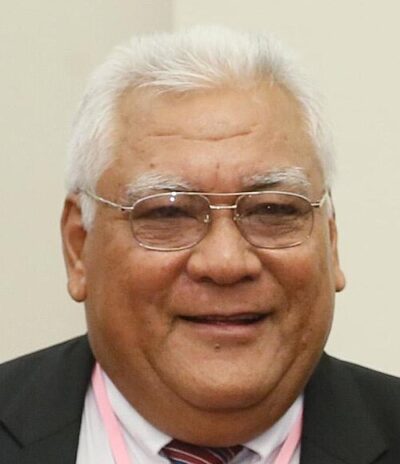
Prime Minister of Tuvalu
Prime Minister of Tuvalu is a public office. It was created in 1978.
All 4 facts, and where they come from
Facts
4 facts · 0 confirmed by two sources · 0 cited · 4 from one source
Where this comes from
Papalocal keeps its own record. It started from these sources; what each one said is kept here as it was copied, so a change on their side never changes this page by itself. Tap one to read its version.
What Wikidata says · copied November 17, 2026 · revision 2561737709
- Described as
- position
- What it is
- public office
- Created
- October 1, 1978
- Country
- Tuvalu
- Office of
- Tuvalu
- Wikipedias with a page
- 20
Wikidata item Q592866 (wikidata.org/wiki/Q592866), public domain (CC0). Copied 2026-11-17.
What Wikipedia says · copied November 17, 2026 · revision 1378137934
The prime minister of Tuvalu is the country's head of government. According to Tuvalu's constitution, the prime minister must always be a member of the parliament and is elected by parliament in a secret ballot. Because there are no political parties in Tuvalu, any member of parliament can be nominated for the role.
Part V, section 62 of the Constitution of Tuvalu describes the vesting of the executive authority:(1) The executive authority of Tuvalu is primarily vested in the Sovereign, and the Governor-General as the representative of the Sovereign.
(2) The executive authority so vested in the Sovereign shall be exercised in accordance with section 53 (performance of functions by the Head of State).
Following the parliamentary vote, the governor-general of Tuvalu is responsible for swearing in as the prime minister the person who commands the confidence of a majority of members of parliament.
Part V of the Constitution establishes the executive authority of Tuvalu and confirms that while the Prime Minister is the head of government, executive power is exercised by ministerial government, with Part V, section 67 to 69 establishing the role of the cabinet.
The office of prime minister was established when Tuvalu gained independence in 1978. However, the post is sometimes considered a continuation of the earlier office of chief minister, created in 1975. If the prime minister dies, as has happened on one occasion, the deputy prime minister becomes acting prime minister until a new one is elected by parliament. The prime minister can lose his office by resigning, being defeated in a motion of no confidence by parliament, or losing his seat in a parliamentary election.
Part V, Section 63 of the Constitution of Tuvalu establishes the office of Prime Minister. Under section 64, the Prime Minister is elected by the members of parliament, with sections 64 to 67 describing what happens if the office of the Prime Minister becomes vacant, the removal from office of an incapacitated Prime Minister, the process for the suspension of the Prime Minister, and the effect of removal or suspension of the Prime Minister.
Until the Second Toafa Ministry in 2010, the prime minister also had the role of foreign minister. Enele Sopoaga was the foreign minister in the short-lived Second Toafa Ministry. In subsequent ministries, foreign affairs was another minister's responsibility in the cabinet.
Several former prime ministers have been appointed the governor-general of Tuvalu.
Feleti Teo was appointed as prime minister on 26 February 2024, after he was elected unopposed by the parliament.
From the Wikipedia article “Prime Minister of Tuvalu” (en.wikipedia.org/wiki/Prime_Minister_of_Tuvalu), by its contributors, under CC BY-SA 4.0 (creativecommons.org/licenses/by-sa/4.0/). Copied 2026-11-17; not changed.
Confirmed Two sources agree. Cited One source, and it names where it got it. One source One source, without a reference of its own. Sources disagree The sources disagree. We show the best-supported value and keep theirs below.