Prolegomena to Any Future Metaphysics
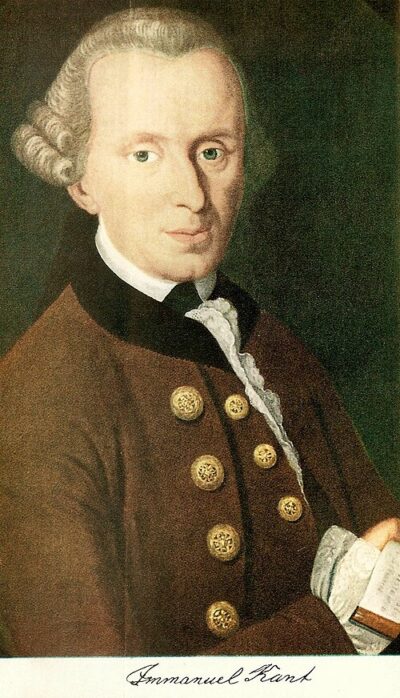
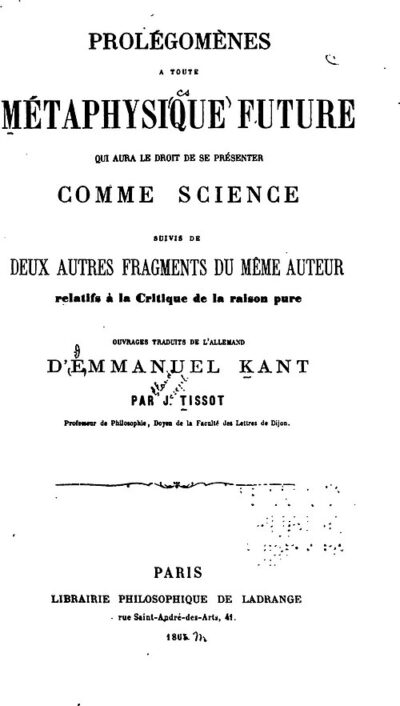
Prolegomena to Any Future Metaphysics is a 1783 book by Immanuel Kant.
- Released
- 1783
- Written by
- Immanuel Kant
- Genre
- essay
All 5 facts, and where they come from
Facts
5 facts · 0 confirmed by two sources · 0 cited · 5 from one source
Where this comes from
Papalocal keeps its own record. It started from these sources; what each one said is kept here as it was copied, so a change on their side never changes this page by itself. Tap one to read its version.
What Wikidata says · copied November 17, 2026 · revision 2552311345
- Described as
- 1783 book by Immanuel Kant
- What it is
- philosophical work
- Written by
- Immanuel Kant
- Genre
- essay · 1 reference
- Released
- 1783
- Language
- German
- Wikipedias with a page
- 23
Wikidata item Q1761342 (wikidata.org/wiki/Q1761342), public domain (CC0). Copied 2026-11-17.
What Wikipedia says · copied November 17, 2026 · revision 1385980759
Prolegomena to Any Future Metaphysics That Will Be Able to Present Itself as a Science (German: Prolegomena zu einer jeden künftigen Metaphysik, die als Wissenschaft wird auftreten können) is a book by German philosopher Immanuel Kant, published in 1783, two years after the first edition of his Critique of Pure Reason. One of Kant's shorter works, it contains a summary of the Critique‘s main conclusions, sometimes by arguments Kant had not used in the Critique. Kant characterizes his more accessible approach here as an "analytic" one, as opposed to the Critique‘s "synthetic" examination of successive faculties of the mind and their principles.
The book is also intended as a polemic. Kant was disappointed by the poor reception of the Critique of Pure Reason, and here he repeatedly emphasizes the importance of its critical project for the very existence of metaphysics as a science. The final appendix contains a response to an unfavorable review of the Critique.
From the Wikipedia article “Prolegomena to Any Future Metaphysics” (en.wikipedia.org/wiki/Prolegomena_to_Any_Future_Metaphysics), by its contributors, under CC BY-SA 4.0 (creativecommons.org/licenses/by-sa/4.0/). Copied 2026-11-17; not changed.
Confirmed Two sources agree. Cited One source, and it names where it got it. One source One source, without a reference of its own. Sources disagree The sources disagree. We show the best-supported value and keep theirs below.
Picture: Emmanuel Kant, via Wikimedia Commons · Public domain