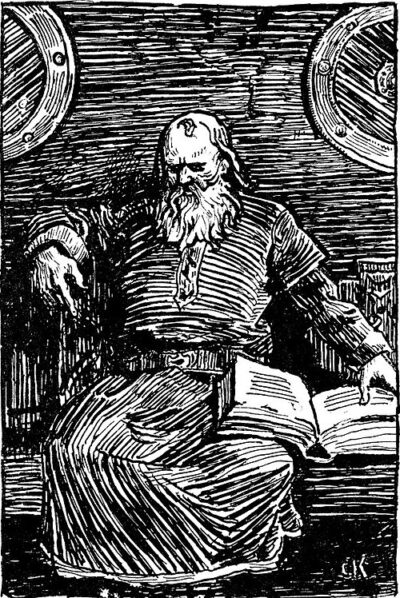
Prose Edda
Prose Edda is a 13th-century Norse work of literature written in Iceland. It came out in 1225. It was written by Snorri Sturluson.
- Came out
- 1225
- Written by
- Snorri Sturluson
- Country of origin
- Iceland
All 8 facts, and where they come from
Facts
8 facts · 0 confirmed by two sources · 2 cited · 6 from one source
Where this comes from
Papalocal keeps its own record. It started from these sources; what each one said is kept here as it was copied, so a change on their side never changes this page by itself. Tap one to read its version.
What Wikidata says · copied November 17, 2026 · revision 2528466633
- Described as
- 13th-century Norse work of literature written in Iceland
- Other names
- Snorra Edda, Younger Edda, Edda
- What it is
- literary work · 1 reference; Norse cultural artifact
- Written by
- Snorri Sturluson · 1 reference
- Language
- Old Norse; Old Icelandic · 1 reference
- Country of origin
- Iceland · 1 reference; Icelandic Commonwealth
- Came out
- 1225
- Wikipedias with a page
- 59
Wikidata item Q205882 (wikidata.org/wiki/Q205882), public domain (CC0). Copied 2026-11-17.
What Wikipedia says · copied November 17, 2026 · revision 1367985894
The Prose Edda, also known as the Younger Edda, Snorri's Edda (Icelandic: Snorra Edda) or, historically, simply as Edda, is an Old Norse textbook written in Iceland during the early 13th century. The work is often considered to have been to some extent written, or at least compiled, by the Icelandic scholar, lawspeaker, and historian Snorri Sturluson c. 1220. It is considered the fullest and most detailed source for modern knowledge of Norse mythology, the body of myths of the North Germanic peoples, and draws from a wide variety of sources, including versions of poems that survive into today in a collection known as the Poetic Edda.
The Prose Edda consists of four sections: The Prologue, a euhemerized account of the Norse gods; Gylfaginning, which provides a question and answer format that details aspects of Norse mythology (consisting of approximately 20,000 words), Skáldskaparmál, which continues this format before providing lists of kennings and heiti (approximately 50,000 words); and Háttatal, which discusses the composition of traditional skaldic poetry (approximately 20,000 words).
Dating from c. 1300 to 1600, seven manuscripts of the Prose Edda differ from one another in notable ways, which provides researchers with independent textual value for analysis. The Prose Edda appears to have functioned similarly to a contemporary textbook, with the goal of assisting Icelandic poets and readers in understanding the subtleties of alliterative verse, and to grasp the meaning behind the many kennings used in skaldic poetry.
Originally known to scholars simply as Edda, the Prose Edda gained its contemporary name in order to differentiate it from the Poetic Edda. Early scholars of the Prose Edda suspected that there once existed a collection of entire poems, a theory confirmed with the rediscovery of manuscripts of the Poetic Edda.
From the Wikipedia article “Prose Edda” (en.wikipedia.org/wiki/Prose_Edda), by its contributors, under CC BY-SA 4.0 (creativecommons.org/licenses/by-sa/4.0/). Copied 2026-11-17; not changed.
Confirmed Two sources agree. Cited One source, and it names where it got it. One source One source, without a reference of its own. Sources disagree The sources disagree. We show the best-supported value and keep theirs below.
Picture: Wikimedia Commons: Edda.jpg · See Commons file page