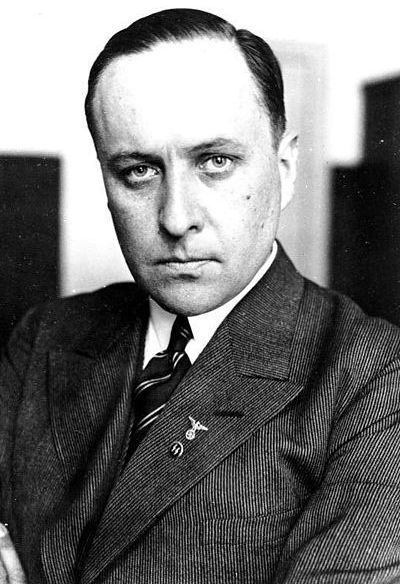
Reichsleiter
Reichsleiter is a second-highest political rank of the Nazi Party. It was created in 1933.
- Created
- 1933
All 3 facts, and where they come from
Facts
3 facts · 0 confirmed by two sources · 0 cited · 3 from one source
Where this comes from
Papalocal keeps its own record. It started from these sources; what each one said is kept here as it was copied, so a change on their side never changes this page by itself. Tap one to read its version.
What Wikidata says · copied November 17, 2026 · revision 2509273420
- Described as
- second-highest political rank of the Nazi Party
- What it is
- rank
- Created
- 1933
- Ended
- 1945
- Wikipedias with a page
- 26
Wikidata item Q1991957 (wikidata.org/wiki/Q1991957), public domain (CC0). Copied 2026-11-17.
What Wikipedia says · copied November 17, 2026 · revision 1321193349
Reichsleiter (German pronunciation: [ˈʁaɪ̯çsˌlaɪ̯tɐ] , transl. national leader or Reich leader) was the second-highest political rank in the Nazi Party (NSDAP), subordinate only to the office of Führer. Reichsleiter also functioned as a paramilitary rank within the NSDAP and was the highest rank attainable in any Nazi organisation.
Each Reichsleiter reported directly to the Führer, Adolf Hitler. Men of the rank Reichsleiter collectively formed part of the Reichsleitung (Reich leadership) of the NSDAP, which was originally located in the "Brown House" in Munich. Each Reichsleiter was in charge of a broad area of responsibility in the party. Hitler originally established the rank of Reichsleiter on 2 June 1933 and appointed 16 individuals to that rank. Subsequently, a further 6 individuals were appointed to the rank between 1933 and 1938: von Epp, Frick, Bormann, Lutze, Hierl and Huhnlein.
From the Wikipedia article “Reichsleiter” (en.wikipedia.org/wiki/Reichsleiter), by its contributors, under CC BY-SA 4.0 (creativecommons.org/licenses/by-sa/4.0/). Copied 2026-11-17; not changed.
Confirmed Two sources agree. Cited One source, and it names where it got it. One source One source, without a reference of its own. Sources disagree The sources disagree. We show the best-supported value and keep theirs below.