Revolutionary Union
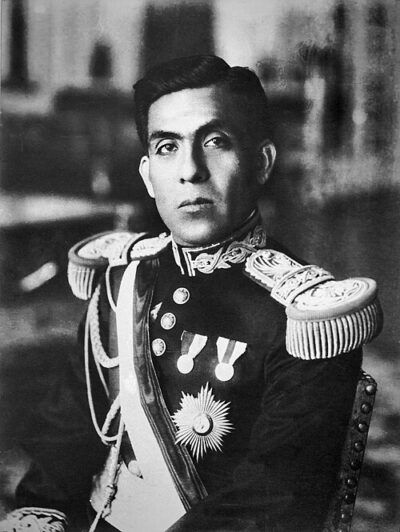
The Revolutionary Union is a Defunct political party in Peru. It was founded in 1931 by Luis Miguel Sánchez Cerro. Its headquarters are in Lima. It stands for nationalism.
- Country
- Peru
- Founded
- 1931
- Ideology
- nationalism
All 7 facts, and where they come from
Facts
7 facts · 0 confirmed by two sources · 0 cited · 7 from one source
Where this comes from
Papalocal keeps its own record. It started from these sources; what each one said is kept here as it was copied, so a change on their side never changes this page by itself. Tap one to read its version.
What Wikidata says · copied November 18, 2026 · revision 2563897783
- Described as
- Defunct political party in Peru
- Other names
- Revolutionary Union Party, Revolutionary Union (Peru)
- What it is
- political party
- Founded
- 1931
- Ended
- 1945
- Founded by
- Luis Miguel Sánchez Cerro · 1 reference
- Headquarters
- Lima
- Country
- Peru
- Ideology
- nationalism
- Wikipedias with a page
- 8
Wikidata item Q6157100 (wikidata.org/wiki/Q6157100), public domain (CC0). Copied 2026-11-18.
What Wikipedia says · copied November 18, 2026 · revision 1295599031
The Revolutionary Union (Spanish: Unión Revolucionaria, UR), was a nationalist political party in Peru founded in 1931 by Luis M. Sánchez Cerro, former president of Peru. The party was formed following the coup with which Sanchez Cerro overthrew the eleven-year dictatorship of Augusto B. Leguía. Initially an authoritarian-populist organization, the party later transitioned towards fascism following the assassination of its founder, with Luis A. Flores assuming leadership in 1933 and consolidating this ideological shift.
As a mass movement, the UR drew significant support from many different groups in Peruvian society, included rural communities, individuals from the Andean and southern regions, women, the unemployed, marginalized groups (lumpen), as well as former civilistas and conservatives. In the elections of 1931, Sánchez Cerro obtained more than 150,000 votes, allowing the aforementioned candidate to lead a second government. The party maintained a populist and nationalist character, and displayed a staunch opposition towards communism and the APRA, organizing armed groups to combat said movements. The UR organized impoverished social sectors in both urban and rural areas. It carried out extensive work among poor women, urban marginalized groups and yanaconas.
The assassination of Sanchez Cerro at the hands of an aprista militant and the assumption of power of the party by Luis A. Flores lead an ideological transition towards fascism. Highly inspired in Italian fascism, the party adopted a similar paramilitary branch called the Legión de Camisas Negras ("Blackshirt Legion"). The UR openly advocated for an armed struggle against leftist forces, under the slogan that fascism means “religiosity, conservatism, and right-wing conduct”. By 1936, the UR had at least 6,000 members among their armed groups. In the elections of that year, Flores lost in second place against Luis Antonio Eguiguren, although the elections were later annulled by the government of Óscar R. Benavides, who would reform the 1933 constitution to extend his term by an additional three years.
The UR saw a loss of support after failure in the elections of 1936. Following the extension of the Benavides’ government, some of the most prominent leaders of both the UR and the APRA would be deported. Deprived of charismatic leadership and overshadowed in popular favour by the new regime's achievements, the UR began a decline that ultimately led to its disappearance in 1956.
From the Wikipedia article “Revolutionary Union (Peru)” (en.wikipedia.org/wiki/Revolutionary_Union_(Peru)), by its contributors, under CC BY-SA 4.0 (creativecommons.org/licenses/by-sa/4.0/). Copied 2026-11-18; not changed.
Confirmed Two sources agree. Cited One source, and it names where it got it. One source One source, without a reference of its own. Sources disagree The sources disagree. We show the best-supported value and keep theirs below.