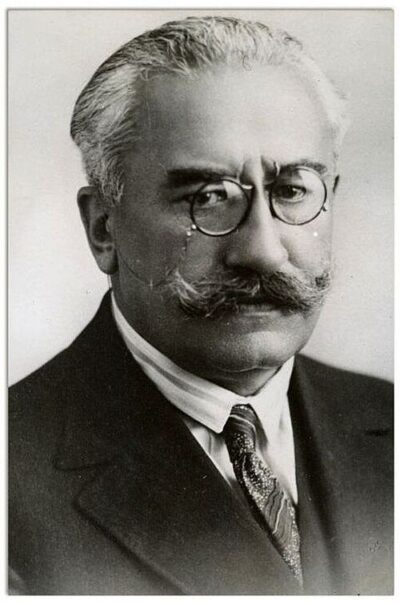
Romanian Front
The Romanian Front is a political party in Romania. It was founded in 1935. It stands for nationalism.
- Country
- Romania
- Founded
- February 25, 1935
- Ideology
- nationalism
All 6 facts, and where they come from
Facts
6 facts · 0 confirmed by two sources · 0 cited · 6 from one source
Where this comes from
Papalocal keeps its own record. It started from these sources; what each one said is kept here as it was copied, so a change on their side never changes this page by itself. Tap one to read its version.
What Wikidata says · copied November 18, 2026 · revision 2552801959
- Described as
- political party in Romania
- What it is
- political party
- Founded
- February 25, 1935
- Ended
- March 30, 1938
- Country
- Romania
- Chair
- Alexandru Vaida-Voevod
- Ideology
- nationalism
- Wikipedias with a page
- 5
Wikidata item Q7362550 (wikidata.org/wiki/Q7362550), public domain (CC0). Copied 2026-11-18.
What Wikipedia says · copied November 18, 2026 · revision 1379461603
The Romanian Front (Romanian: Frontul Românesc, FR) was a fascist party created in Romania in 1935. Led by former Prime Minister Alexandru Vaida-Voevod, it originated as a right-wing splinter group from the mainstream National Peasants' Party (PNȚ). While in power, Vaida had an ambiguous approach to the Iron Guard, and constructed his own radical ideology; the FR had a generally xenophobic program of positive discrimination, being implicitly (and eventually explicitly) antisemitic. It was subsumed to the policies of King Carol II, maneuvering between the mainstream National Liberals, the PNȚ's left-wing, and the more radically fascist Guardists. Vaida tried to compete with the former two and appease the latter, assuming fascist trappings such as the black-shirted uniform. Like the Guard, he supported aligning Romania with the Axis powers, though he also hoped to obtain their guarantees for Greater Romania's borders. The FR's lower echelons included Viorel Tilea and other opponents of Vaida's approach, who believed in Romania's attachments to the League of Nations and the Little Entente.
Albeit invested with the king's trust and counting experienced politicians among its cadres, the FR was always a minor force in Romanian politics, and was habitually defeated in by-elections. Its peak influence was recorded during the local elections of June 1937, when it emerged as the second most popular party in Ilfov County. Early on, it was courted by other radical groups, narrowly failing to absorb the National Agrarian Party. It came to depend on the more powerful National Christian Party, with which it formed a political alliance in 1935. Called "National Bloc", it too failed to produce a full merger between its components, as Vaida had qualms about the unchecked Germanophilia of his partners; his Romanianization project was also regarded as too mild by National Christian standards. In later years, the FR made several sustained efforts to reunite with, or to absorb, the "centrist" wing of the PNȚ.
The FR's hostility toward successive National Liberal governments gave way to cooperation after the latter also embraced ethnic discrimination. This rapprochement eventually resulted in a cartel, formed by the two parties during the 1937 general election. This controversial move bled the FR of members and supporters, including a massive defection by D. R. Ioanițescu and his supporters. After the country witnessed a descent into political violence with clashes between monarch and the Guardists, the Front allowed itself to be absorbed into Carol's sole legal party, the National Renaissance Front in 1938. From 1940, Vaida served as the Front's Chairman.
From the Wikipedia article “Romanian Front” (en.wikipedia.org/wiki/Romanian_Front), by its contributors, under CC BY-SA 4.0 (creativecommons.org/licenses/by-sa/4.0/). Copied 2026-11-18; not changed.
Confirmed Two sources agree. Cited One source, and it names where it got it. One source One source, without a reference of its own. Sources disagree The sources disagree. We show the best-supported value and keep theirs below.