
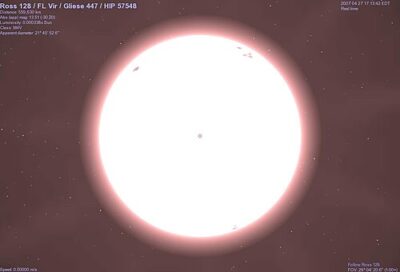
Ross 128
Ross 128 is a small star in the equatorial zodiac constellation of Virgo.
All 3 facts, and where they come from
Facts
3 facts · 0 confirmed by two sources · 2 cited · 1 from one source
Where this comes from
Papalocal keeps its own record. It started from these sources; what each one said is kept here as it was copied, so a change on their side never changes this page by itself. Tap one to read its version.
What Wikidata says · copied November 17, 2026 · revision 2469727104
- Described as
- small star in the equatorial zodiac constellation of Virgo
- Other names
- FI Virginis, FI Vir, GJ 447, Zkh 169, PLX 2730, EPIC 201518346, ASCC 1136005, GAT 1131, GAT 1132, GCRV 7139, G 10-50, G 11-22
- What it is
- star · 1 reference; variable star · 1 reference; red dwarf
- Wikipedias with a page
- 35
Wikidata item Q926610 (wikidata.org/wiki/Q926610), public domain (CC0). Copied 2026-11-17.
What Wikipedia says · copied November 17, 2026 · revision 1377084550
Ross 128 is a red dwarf star in the equatorial zodiac constellation of Virgo, near β Virginis. The apparent magnitude of Ross 128 is 11.13, which is too faint to be seen with the unaided eye. Based upon parallax measurements, the distance of this star from Earth is 11.007 light-years (3.375 parsecs), making it the twelfth closest stellar system to the Solar System. It was first cataloged in 1926 by American astronomer Frank Elmore Ross. It is the nearest star in Virgo, and so is occasionally called "Proxima Virginis" by analogy with Proxima Centauri.
From the Wikipedia article “Ross 128” (en.wikipedia.org/wiki/Ross_128), by its contributors, under CC BY-SA 4.0 (creativecommons.org/licenses/by-sa/4.0/). Copied 2026-11-17; not changed.
Confirmed Two sources agree. Cited One source, and it names where it got it. One source One source, without a reference of its own. Sources disagree The sources disagree. We show the best-supported value and keep theirs below.
Picture: Taken by me using Celestia, via Wikimedia Commons · See Commons file page
