Saint Barbara
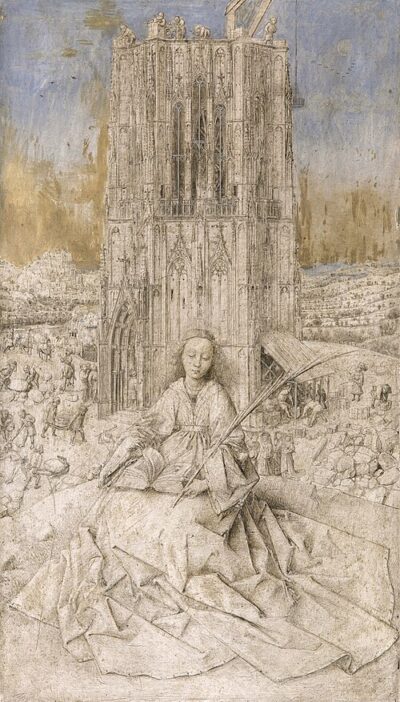
Saint Barbara is a drawing by Jan van Eyck. It came out in 1437.
- Came out
- 1437
- Created by
- Jan van Eyck
- Genre
- religious art
All 8 facts, and where they come from
Facts
8 facts · 0 confirmed by two sources · 4 cited · 4 from one source
Where this comes from
Papalocal keeps its own record. It started from these sources; what each one said is kept here as it was copied, so a change on their side never changes this page by itself. Tap one to read its version.
What Wikidata says · copied November 17, 2026 · revision 2556885958
- Described as
- drawing by Jan van Eyck
- Other names
- Saint Barbara of Nicodemia
- What it is
- drawing; painting
- Created by
- Jan van Eyck · 1 reference
- Genre
- religious art
- Came out
- 1437 · 1 reference
- Country
- Belgium
- Owned by
- Lucas de Heere · 1 reference; Johannes Enschedé I · 1 reference
- Wikipedias with a page
- 11
Wikidata item Q3464466 (wikidata.org/wiki/Q3464466), public domain (CC0). Copied 2026-11-17.
What Wikipedia says · copied November 17, 2026 · revision 1365869302
Saint Barbara is a small 1437 drawing on oak panel, signed and dated 1437 by the Netherlandish artist Jan van Eyck. It is unknown if the work is a chalk ground study in pencil for a planned oil painting, an unfinished underdrawing or a completed work in of itself, although the latter is deemed more likely. The panel shows Saint Barbara imprisoned in a tower by her pagan father to preserve her from the outside world, especially from suitors he did not approve of. While there, she converted to Christianity, enraging her father and leading to her murder and martyrdom.
Art historians debate whether the work is an unfinished painting or a complete drawing or study. The panel was completed with brush strokes, a stylus, silverpoint, ink, oil and black pigment on a chalk ground. The blue and ultramarine paint may be later additions.
Some areas of the panel are more detailed than others, and it has long been debated if it is an autonomous drawing or the underdrawing for a lost painting. If intended as a finished work, it would be the earliest surviving drawing of any artist, although not prepared on paper or parchment. Evidence includes that the work was highly regarded at the time by Flemish aesthetics as an object in itself.
From the Wikipedia article “Saint Barbara (van Eyck)” (en.wikipedia.org/wiki/Saint_Barbara_(van_Eyck)), by its contributors, under CC BY-SA 4.0 (creativecommons.org/licenses/by-sa/4.0/). Copied 2026-11-17; not changed.
Confirmed Two sources agree. Cited One source, and it names where it got it. One source One source, without a reference of its own. Sources disagree The sources disagree. We show the best-supported value and keep theirs below.
Picture: Jan van Eyck, via Wikimedia Commons · CC0