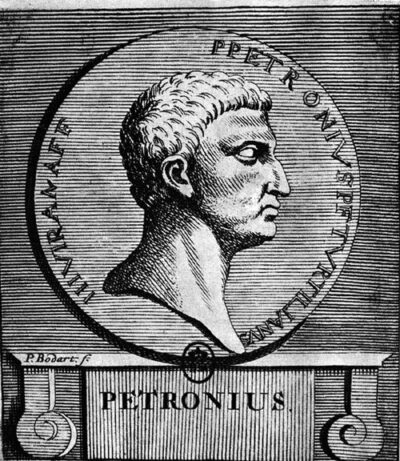
Satyricon
Satyricon is a 1st century Latin work of fiction attributed to Petronius.
- Came out
- 1st century
- Written by
- Petronius
- Genre
- Menippean satire
- Country of origin
- Roman Empire
All 7 facts, and where they come from
Facts
7 facts · 0 confirmed by two sources · 1 cited · 6 from one source
Where this comes from
Papalocal keeps its own record. It started from these sources; what each one said is kept here as it was copied, so a change on their side never changes this page by itself. Tap one to read its version.
What Wikidata says · copied November 17, 2026 · revision 2541296521
- Described as
- 1st century Latin work of fiction attributed to Petronius
- Other names
- Petr.
- What it is
- literary work
- Written by
- Petronius
- Genre
- Menippean satire; erotica
- Language
- Latin · 1 reference
- Country of origin
- Roman Empire
- Came out
- 1st century
- Wikipedias with a page
- 39
Wikidata item Q246732 (wikidata.org/wiki/Q246732), public domain (CC0). Copied 2026-11-17.
What Wikipedia says · copied November 17, 2026 · revision 1386021228
The Satyricon, Satyricon liber (The Book of Satyrlike Adventures), or Satyrica, is a Latin work of fiction believed to have been written by Gaius Petronius in the late 1st century AD, though the manuscript tradition identifies the author as Titus Petronius. The Satyricon is an example of Menippean satire, which is different from the formal verse satire of Juvenal or Horace. The work contains a mixture of prose and verse (commonly known as prosimetrum); serious and comic elements; and erotic and decadent passages. As with The Golden Ass by Apuleius (also called the Metamorphoses), classical scholars often describe it as a Roman novel, without necessarily implying continuity with the modern literary form.
The surviving sections of the original (much longer) text detail the bizarre exploits of the narrator, Encolpius, and his (possible) slave and catamite Giton, a handsome sixteen-year-old boy. It is the second most fully preserved Roman novel, after the fully extant The Golden Ass by Apuleius, which has significant differences in style and plot. Satyricon is also regarded as useful evidence for the reconstruction of how lower classes lived during the early Roman Empire.
From the Wikipedia article “Satyricon” (en.wikipedia.org/wiki/Satyricon), by its contributors, under CC BY-SA 4.0 (creativecommons.org/licenses/by-sa/4.0/). Copied 2026-11-17; not changed.
Confirmed Two sources agree. Cited One source, and it names where it got it. One source One source, without a reference of its own. Sources disagree The sources disagree. We show the best-supported value and keep theirs below.
Picture: Wikimedia Commons: SatyriconPithou1587.svg · See Commons file page