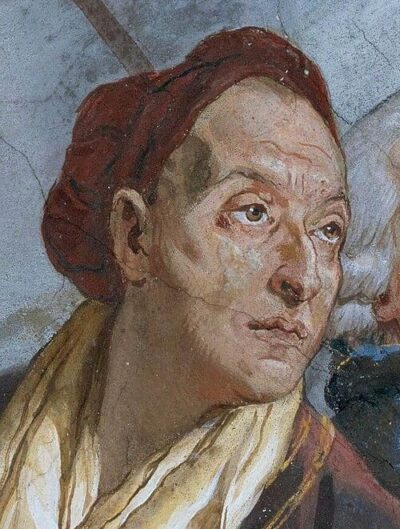
Scipio Africanus Freeing Massiva
Scipio Africanus Freeing Massiva is a painting by Giovanni Battista Tiepolo. It came out in 1719.
- Came out
- 1719
- Created by
- Giovanni Battista Tiepolo
- Genre
- history painting
All 4 facts, and where they come from
Facts
4 facts · 0 confirmed by two sources · 0 cited · 4 from one source
Where this comes from
Papalocal keeps its own record. It started from these sources; what each one said is kept here as it was copied, so a change on their side never changes this page by itself. Tap one to read its version.
What Wikidata says · copied November 17, 2026 · revision 2539689723
- Described as
- painting by Giovanni Battista Tiepolo
- What it is
- painting
- Created by
- Giovanni Battista Tiepolo
- Genre
- history painting
- Came out
- 1719
- Wikipedias with a page
- 6
Wikidata item Q38197 (wikidata.org/wiki/Q38197), public domain (CC0). Copied 2026-11-17.
What Wikipedia says · copied November 17, 2026 · revision 1361378161
Scipio Africanus Freeing Massiva (alt. Scipio Liberating Massiva) is a painting depicting a scene from ancient Roman history by the Venetian artist Giovanni Battista Tiepolo (alt. Giambattista Tiepolo), painted between 1719 and 1721. The painting depicts the Roman general Scipio Africanus after the 209 BCE Battle of Baecula in present-day Spain where he defeated the Carthaginians, capturing their Iberian and North African allies. The painting details the moment in which one of the captured Africans is brought before Scipio, who recognises him to be Massiva, the nephew of a chieftain of Eastern Numidia, Massinissa. Scipio reportedly frees Massiva, sending him home to his uncle laden with gifts and so winning Massinissa's loyalty for Rome.
Giovanni Battista Tiepolo (1696-1770) was an Italian painter and etcher most famous for his decorative fresco cycles. Tiepolo joined the Venetian painters’ confraternity in 1717 at twenty one years of age. His patrons included such people as doge Giovanni II Cornaro, archbishop Dionisio Dolfin of Udine, the Swedish ambassador Count Carl Gustaf Tessin and Charles III of Spain. Tiepolo died in Madrid while working for Charles III and his work quickly went out of style. Tiepolo's works, especially his frescoes, were developed through a process of drawings and oil sketching and then finally he would work onto the wall where the fresco would be. Tiepolo's work was famous, and is still highly regarded today, for his responses to the light at the site where the painting was to the executed and how this affected his processes.
From the Wikipedia article “Scipio Africanus Freeing Massiva” (en.wikipedia.org/wiki/Scipio_Africanus_Freeing_Massiva), by its contributors, under CC BY-SA 4.0 (creativecommons.org/licenses/by-sa/4.0/). Copied 2026-11-17; not changed.
Confirmed Two sources agree. Cited One source, and it names where it got it. One source One source, without a reference of its own. Sources disagree The sources disagree. We show the best-supported value and keep theirs below.
Picture: Wikimedia Commons: Giovanni Battista Tiepolo - Scipio Africanus Freeing Massiva - Walters 37657.jpg · See Commons file page