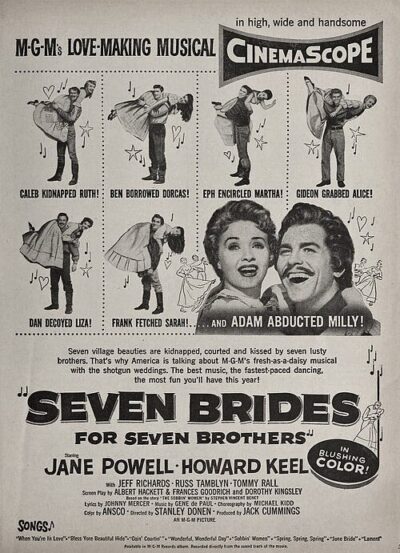
Seven Brides for Seven Brothers
Seven Brides for Seven Brothers is a 1954 film by Stanley Donen. It stars Howard Keel, Ruta Lee and Jeff Richards. It won the Academy Award for Best Original Musical Score and 1 more.
- Released
- July 15, 1954
- Directed by
- Stanley Donen
- Genre
- romantic comedy film
- Country of origin
- United States
All 25 facts, and where they come from
Facts
25 facts · 0 confirmed by two sources · 16 cited · 9 from one source
Where this comes from
Papalocal keeps its own record. It started from these sources; what each one said is kept here as it was copied, so a change on their side never changes this page by itself. Tap one to read its version.
What Wikidata says · copied November 17, 2026 · revision 2564842347
- Described as
- 1954 film by Stanley Donen
- What it is
- film
- Directed by
- Stanley Donen · 3 references
- Music by
- Gene de Paul
- Screenplay by
- Albert Hackett · 1 reference; Frances Goodrich · 1 reference; Dorothy Kingsley · 1 reference
- Produced by
- Jack Cummings
- Starring
- Howard Keel · 2 references; Ruta Lee · 1 reference; Jeff Richards · 2 references; Russ Tamblyn · 2 references; Jacques d'Amboise · 1 reference; Howard Petrie · 1 reference; Matt Mattox · 1 reference; Virginia Gibson · 1 reference; Jane Powell · 2 references; Julie Newmar · 1 reference
- Genre
- romantic comedy film; musical film · 1 reference
- Released
- July 15, 1954; July 22, 1954; December 20, 1954
- Original language
- English
- Country of origin
- United States
- Awards
- Academy Award for Best Original Musical Score (1955) · 1 reference; National Board of Review: Top Ten Films
- Official website
- https://www.warnerbros.com/movies/seven-brides-seven-brothers
- Wikipedias with a page
- 35
Wikidata item Q662679 (wikidata.org/wiki/Q662679), public domain (CC0). Copied 2026-11-17.
What Wikipedia says · copied November 17, 2026 · revision 1378849707
Seven Brides for Seven Brothers is a 1954 American musical film, directed by Stanley Donen, with music by Gene de Paul, lyrics by Johnny Mercer, and choreography by Michael Kidd. The screenplay, by Albert Hackett, Frances Goodrich, and Dorothy Kingsley, is based on the short story "The Sobbin' Women" by Stephen Vincent Benét, which was based in turn on the ancient Roman legend of the Rape of the Sabine women. Seven Brides for Seven Brothers, which is set in Oregon in 1850, is famous for Kidd's unusual choreography, which makes dance numbers out of such mundane frontier pursuits as chopping wood and barn raising. Film critic Stephanie Zacharek has called the barn-raising sequence in Seven Brides "one of the most rousing dance numbers ever put on screen." The film was photographed in Ansco Color in the CinemaScope format.
Seven Brides for Seven Brothers won the Academy Award for Best Scoring of a Musical Picture and was nominated for four additional awards, including Best Picture. In 2006, American Film Institute named Seven Brides for Seven Brothers as one of the best American musical films ever made. In late 2004, the same year Howard Keel died, Seven Brides for Seven Brothers was selected for preservation in the U.S. National Film Registry of the Library of Congress as being "culturally, historically, or aesthetically significant."
From the Wikipedia article “Seven Brides for Seven Brothers” (en.wikipedia.org/wiki/Seven_Brides_for_Seven_Brothers), by its contributors, under CC BY-SA 4.0 (creativecommons.org/licenses/by-sa/4.0/). Copied 2026-11-17; not changed.
Confirmed Two sources agree. Cited One source, and it names where it got it. One source One source, without a reference of its own. Sources disagree The sources disagree. We show the best-supported value and keep theirs below.
Picture: Metro-Goldwyn-Mayer, via Wikimedia Commons · Public domain