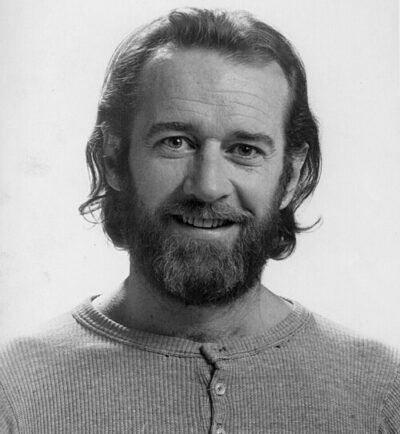
seven dirty words
Seven dirty words is a George Carlin's list of "Seven Words You Can Never Say on Television" or "Filthy Words".
- Written by
- George Carlin
All 3 facts, and where they come from
Facts
3 facts · 0 confirmed by two sources · 0 cited · 3 from one source
Where this comes from
Papalocal keeps its own record. It started from these sources; what each one said is kept here as it was copied, so a change on their side never changes this page by itself. Tap one to read its version.
What Wikidata says · copied November 16, 2026 · revision 2541742752
- Described as
- George Carlin's list of "Seven Words You Can Never Say on Television" or "Filthy Words"
- Other names
- 7 dirty words, shit, piss, fuck, cunt, cocksucker, motherfucker, tits, Seven Words You Can Never Say on Television
- What it is
- word list; stand-up comedy
- Written by
- George Carlin
- Wikipedias with a page
- 20
Wikidata item Q1353155 (wikidata.org/wiki/Q1353155), public domain (CC0). Copied 2026-11-16.
What Wikipedia says · copied November 16, 2026 · revision 1383664230
The seven dirty words are seven English-language profanities that the American comedian George Carlin first listed in his 1972 "Seven Words You Can Never Say on Television" monologue. The words, in the order Carlin listed them, are: "shit", "piss", "fuck", "cunt", "cocksucker", "motherfucker", and "tits".
These words were considered highly inappropriate and unsuitable for broadcast on the public airwaves in the United States, whether radio or television. As such, they were avoided in scripted material and bleep censored in the rare cases in which they were used. Broadcast standards differ in different parts of the world, then and now, although most of the words on Carlin's original list remain taboo on American broadcast television. Nonetheless, a radio broadcast featuring these words led to the U.S. Supreme Court's 5–4 decision in 1978 in FCC v. Pacifica Foundation that the Federal Communication Commission's declaratory ruling upholding a 1973 complaint about Carlin's routine being broadcast at 2 p.m. violated neither the First nor the Fifth Amendment to the U.S. Constitution, thus helping to define the extent to which the U.S. federal government could regulate speech on broadcast television and radio.
From the Wikipedia article “Seven dirty words” (en.wikipedia.org/wiki/Seven_dirty_words), by its contributors, under CC BY-SA 4.0 (creativecommons.org/licenses/by-sa/4.0/). Copied 2026-11-16; not changed.
Confirmed Two sources agree. Cited One source, and it names where it got it. One source One source, without a reference of its own. Sources disagree The sources disagree. We show the best-supported value and keep theirs below.
Picture: Wikimedia Commons: Seven Dirty Words WBAI.jpg · See Commons file page