Snell's law
Snell's law is a formula deriving the angle of refraction of light between two mediums.
All 1 facts, and where they come from
Facts
1 facts · 0 confirmed by two sources · 0 cited · 1 from one source
Where this comes from
Papalocal keeps its own record. It started from these sources; what each one said is kept here as it was copied, so a change on their side never changes this page by itself. Tap one to read its version.
What Wikidata says · copied November 17, 2026 · revision 2556460199
- Described as
- formula deriving the angle of refraction of light between two mediums
- Other names
- Snell–Descartes law, law of refraction
- Named after
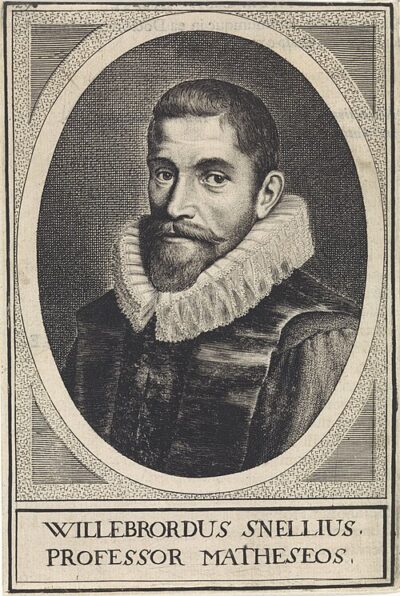
- Willebrord Snellius
- Wikipedias with a page
- 57
Wikidata item Q208391 (wikidata.org/wiki/Q208391), public domain (CC0). Copied 2026-11-17.
What Wikipedia says · copied November 17, 2026 · revision 1379958766
Snell's law (also known as the Snell–Descartes law, and the law of refraction) is a formula used to describe the relationship between the angles of incidence and refraction, when referring to light or other waves passing through a boundary between two different isotropic media, such as water, glass, or air.
In optics, the law is used in ray tracing to compute the angles of transmission or refraction, and in experimental optics to find the refractive index of a material. The law is also satisfied in meta-materials, which allow light to be bent "backward" at a negative angle of refraction with a negative refractive index.
The law states that, for a given pair of media, the ratio of the sines of angle of incidence (θ1) and angle of refraction (θ2) is equal to the refractive index of the second medium with regard to the first (n2,1) which is equal to the ratio of the refractive indices (n2n1) of the two media, or equivalently, to the ratio of the phase velocities (v1v2) in the two media.
sinθ1sinθ2=n2,1=n2n1=v1v2
The law follows from Fermat's principle of least time, which in turn follows from the propagation of light as waves.
From the Wikipedia article “Snell's law” (en.wikipedia.org/wiki/Snell's_law), by its contributors, under CC BY-SA 4.0 (creativecommons.org/licenses/by-sa/4.0/). Copied 2026-11-17; not changed.
Confirmed Two sources agree. Cited One source, and it names where it got it. One source One source, without a reference of its own. Sources disagree The sources disagree. We show the best-supported value and keep theirs below.
Picture: Wikimedia Commons: Fénytörés.jpg · See Commons file page