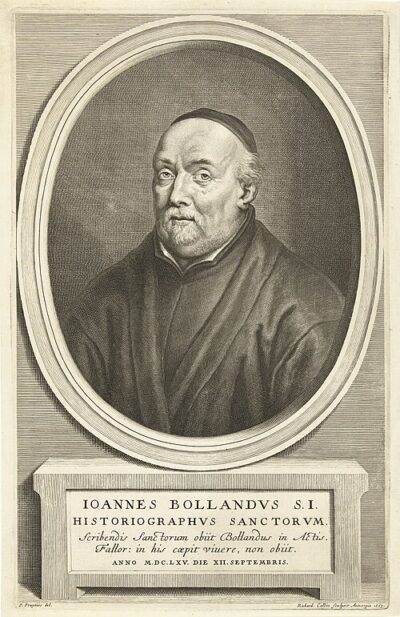
Society of Bollandists
The Society of Bollandists is an association of scholars who study hagiography and the saints in Christianity. It was founded by Jean Bolland. Its headquarters are in Etterbeek.
- Founded
- 17th century
- Founded by
- Jean Bolland
- Headquarters
- Etterbeek
- Industry
- higher education
- Country
- Belgium
All 10 facts, and where they come from
Facts
10 facts · 0 confirmed by two sources · 1 cited · 9 from one source
Where this comes from
Papalocal keeps its own record. It started from these sources; what each one said is kept here as it was copied, so a change on their side never changes this page by itself. Tap one to read its version.
What Wikidata says · copied November 18, 2026 · revision 2522324303
- Described as
- association of scholars who study hagiography and the saints in Christianity
- Other names
- Bollandists
- What it is
- learned society
- Founded
- 17th century
- Founded by
- Jean Bolland
- Headquarters
- Etterbeek
- Country
- Belgium · 1 reference
- Industry
- higher education
- Chair
- Robert Godding (1998–)
- Field
- hagiography
- Named after
- Jean Bolland
- Official website
- http://www.bollandistes.org/
- Wikipedias with a page
- 22
Wikidata item Q670974 (wikidata.org/wiki/Q670974), public domain (CC0). Copied 2026-11-18.
What Wikipedia says · copied November 18, 2026 · revision 1361929429
The Society of Bollandists (Latin: Societas Bollandistarum; French: Société des Bollandistes) is an association of scholars, philologists, and historians (originally all Jesuits, but now including non-Jesuits) who since the early seventeenth century have studied hagiography and the cult of the saints in Christianity. Their most important publication has been the Acta Sanctorum (The Acts of the Saints). They are named after the Flemish Jesuit Jean Bolland (1596–1665).
From the Wikipedia article “Bollandist” (en.wikipedia.org/wiki/Bollandist), by its contributors, under CC BY-SA 4.0 (creativecommons.org/licenses/by-sa/4.0/). Copied 2026-11-18; not changed.
Confirmed Two sources agree. Cited One source, and it names where it got it. One source One source, without a reference of its own. Sources disagree The sources disagree. We show the best-supported value and keep theirs below.