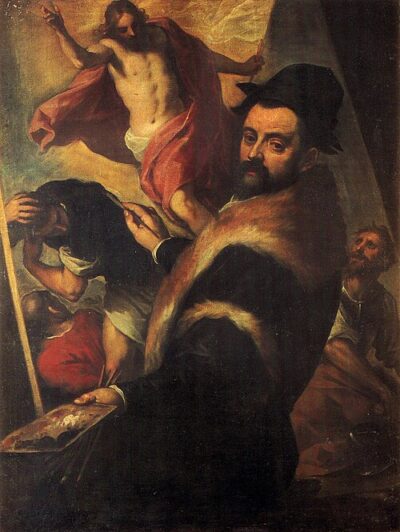
St Jerome Reading in the Desert
St Jerome Reading in the Desert is a painting after Palma Giovane. It was created by Palma il Giovane.
- Came out
- 1590s
- Created by
- Palma il Giovane
- Genre
- religious art
All 6 facts, and where they come from
Facts
6 facts · 0 confirmed by two sources · 0 cited · 6 from one source
Where this comes from
Papalocal keeps its own record. It started from these sources; what each one said is kept here as it was copied, so a change on their side never changes this page by itself. Tap one to read its version.
What Wikidata says · copied November 18, 2026 · revision 2289863693
- Described as
- painting after Palma Giovane
- Other names
- The Francesco St Jerome
- What it is
- painting
- Created by
- Palma il Giovane
- Genre
- religious art
- Came out
- 1590s
- Named after
- Francesco Maria II della Rovere
- Official website
- http://www.freewebs.com/thefrancescostjerome/
- Wikipedias with a page
- 1
Wikidata item Q13365785 (wikidata.org/wiki/Q13365785), public domain (CC0). Copied 2026-11-18.
What Wikipedia says · copied November 18, 2026 · revision 1336358456
A copy of a lost St Jerome, in oils on copper, is attributed to the circle of the Italian Renaissance artist Palma the Younger, dated to the early 17th century. It is in a private collection. It measures 26.3 x 22.2 cm.
The painting was believed to possibly be the lost original work by Palma when it was rediscovered in January 2008 and became known to the public upon its featuring in a number of newspapers in the United Kingdom and around the world.It is sometimes called the Francesco St Jerome, after Palma's patron, Francesco Maria II della Rovere, Duke of Urbino. According to Carlo Ridolfi's 17th century biography of Palms, the Duke commissioned the original painting of the composition, which is now lost, although several other Palma paintings of Jerome have survived. This however is the finest and closest example to engravings of the lost original.
After its discovery, the painting was loaned for two years to The Courtauld Institute in London as a teaching aid to students. Offering for academic study a rare surviving example of copper painting from the period, This included extensive research and restoration in an attempt to ascertain its authorship.
The painting dates from the height of Palma's fame and artistic ability and was most likely created by one of his students or a pupil in the workshop of Hendrik Goltzius, who produced an engraving of the composition, dated 1596. The painting follows the engraving very closely in most respects. The painting has fine detail and vividly bright colours; paintings on copper often retain their brightness and condition better than those on canvas. The work is currently in the collection of the Redingensian, an independent museum in Berkshire, UK.
From the Wikipedia article “St Jerome (after Palma Giovane)” (en.wikipedia.org/wiki/St_Jerome_(after_Palma_Giovane)), by its contributors, under CC BY-SA 4.0 (creativecommons.org/licenses/by-sa/4.0/). Copied 2026-11-18; not changed.
Confirmed Two sources agree. Cited One source, and it names where it got it. One source One source, without a reference of its own. Sources disagree The sources disagree. We show the best-supported value and keep theirs below.
Picture: Wikimedia Commons: Francescostjerome.jpg · See Commons file page