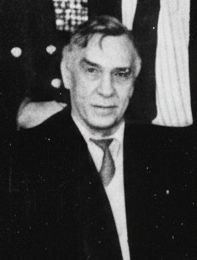
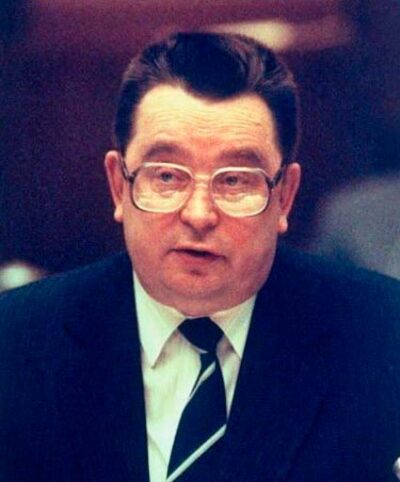
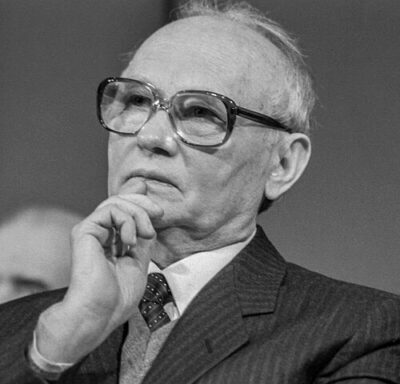
State Committee on the State of Emergency
The State Committee on the State of Emergency is a Government organization in USSR in 1991. Its headquarters are in Moscow. It has 8 employees (1991).
- Founded
- August 18, 1991
- Headquarters
- Moscow
- Employees
- 8 (1991)
- Country
- Soviet Union
All 8 facts, and where they come from
Facts
8 facts · 0 confirmed by two sources · 0 cited · 8 from one source
Where this comes from
Papalocal keeps its own record. It started from these sources; what each one said is kept here as it was copied, so a change on their side never changes this page by itself. Tap one to read its version.
What Wikidata says · copied November 17, 2026 · revision 2532854551
- Described as
- Government organization in USSR in 1991
- Other names
- Gang of Eight
- What it is
- governing body · 2 references
- Founded
- August 18, 1991
- Ended
- August 22, 1991
- Headquarters
- Moscow
- Located in
- Soviet Union · 1 reference
- Country
- Soviet Union
- Chair
- Gennady Yanayev (1991)
- Employees
- 8 (1991) · 1 reference
- Wikipedias with a page
- 30
Wikidata item Q3684508 (wikidata.org/wiki/Q3684508), public domain (CC0). Copied 2026-11-17.
What Wikipedia says · copied November 17, 2026 · revision 1377663348
The State Committee on the State of Emergency (Russian: Государственный комитет по чрезвычайному положению, romanized: Gosudarstvenny komitet po chrezvychaynomu polozheniyu, IPA: [ɡəsʊˈdarstvʲɪn(ː)ɨj kəmʲɪˈtʲet pə tɕrʲɪzvɨˈtɕæjnəmʊ pəlɐˈʐɛnʲɪjʊ]), abbreviated as GKChP (Russian: ГКЧП) or SCSE, was a self-proclaimed political body in the Soviet Union that existed from 19 to 21 August 1991. It included a group of eight high-level Soviet officials within the Soviet government, the Communist Party, and the KGB, who attempted a coup d'état against Mikhail Gorbachev on 19 August 1991. The coup ultimately failed, with the provisional government collapsing by 22 August 1991 and several of the conspirators being prosecuted by the Supreme Court of the Russian Federation.
From 22 to 29 August 1991, former members of the dissolved SCSE and those who actively assisted them were arrested, but from June 1992 to January 1993, they were all released on their own recognizance. In April 1993, the trial began. On 23 February 1994, the defendants in the SCSE case were amnestied by the State Duma of the Federal Assembly of the Russian Federation, despite Yeltsin's objection. One of the defendants, General V.I. Varennikov, refused to accept the amnesty and his trial continued, which he ultimately won.
Diplomatic support came from several countries and entities, such as Afghanistan, China, Cuba, Iraq, Laos, Libya, North Korea, the Palestine Liberation Organization, Vietnam, Serbia, and Montenegro.
From the Wikipedia article “State Committee on the State of Emergency” (en.wikipedia.org/wiki/State_Committee_on_the_State_of_Emergency), by its contributors, under CC BY-SA 4.0 (creativecommons.org/licenses/by-sa/4.0/). Copied 2026-11-17; not changed.
Confirmed Two sources agree. Cited One source, and it names where it got it. One source One source, without a reference of its own. Sources disagree The sources disagree. We show the best-supported value and keep theirs below.