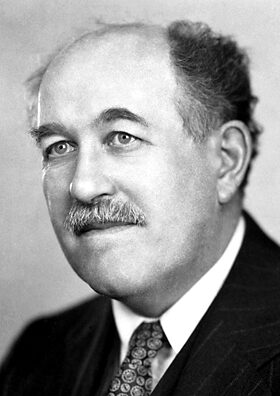
Stern–Gerlach experiment
Stern–Gerlach experiment is a physical experiment that demonstrated the quantization of angular momentum.
All 3 facts, and where they come from
Facts
3 facts · 0 confirmed by two sources · 0 cited · 3 from one source
Where this comes from
Papalocal keeps its own record. It started from these sources; what each one said is kept here as it was copied, so a change on their side never changes this page by itself. Tap one to read its version.
What Wikidata says · copied November 16, 2026 · revision 2568784440
- Described as
- physical experiment that demonstrated the quantization of angular momentum
- What it is
- physics experiment
- Named after
- Otto Stern; Walter Gerlach
- Wikipedias with a page
- 43
Wikidata item Q743142 (wikidata.org/wiki/Q743142), public domain (CC0). Copied 2026-11-16.
What Wikipedia says · copied November 16, 2026 · revision 1374154125
In quantum physics, the Stern–Gerlach experiment demonstrated that the spatial orientation of angular momentum is quantized. Thus an atomic-scale system was shown to have intrinsically quantum properties. In the original experiment, silver atoms were sent through a spatially varying magnetic field, which deflected them before they struck a detector screen, such as a glass slide. Particles with non-zero magnetic moment were deflected, owing to the magnetic field gradient, from a straight path. The screen revealed discrete points of accumulation, rather than a continuous distribution, owing to their quantized spin. Historically, this experiment was decisive in convincing physicists of the reality of angular-momentum quantization in all atomic-scale systems.
After its conception by Otto Stern in 1921, the experiment was first successfully conducted with Walther Gerlach in early 1922.
From the Wikipedia article “Stern–Gerlach experiment” (en.wikipedia.org/wiki/Stern–Gerlach_experiment), by its contributors, under CC BY-SA 4.0 (creativecommons.org/licenses/by-sa/4.0/). Copied 2026-11-16; not changed.
Confirmed Two sources agree. Cited One source, and it names where it got it. One source One source, without a reference of its own. Sources disagree The sources disagree. We show the best-supported value and keep theirs below.
Picture: Wikimedia Commons: Stern-Gerlach-Experiment.jpg · See Commons file page