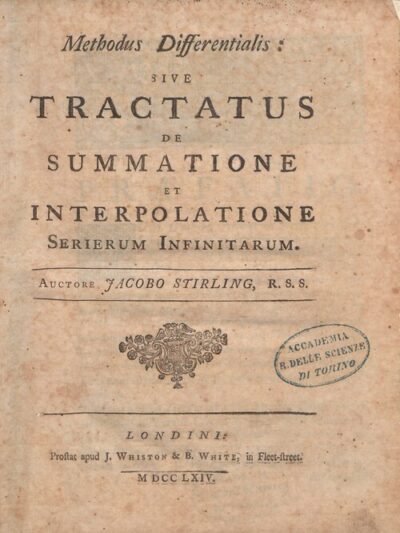
Stirling's approximation
Stirling's approximation is an approximation for factorials.
All 2 facts, and where they come from
Facts
2 facts · 0 confirmed by two sources · 0 cited · 2 from one source
Where this comes from
Papalocal keeps its own record. It started from these sources; what each one said is kept here as it was copied, so a change on their side never changes this page by itself. Tap one to read its version.
What Wikidata says · copied November 17, 2026 · revision 2541575986
- Described as
- approximation for factorials
- Other names
- Stirling's formula
- What it is
- theorem
- Named after
- James Stirling
- Wikipedias with a page
- 43
Wikidata item Q470877 (wikidata.org/wiki/Q470877), public domain (CC0). Copied 2026-11-17.
What Wikipedia says · copied November 17, 2026 · revision 1382535353
In mathematics, Stirling's approximation (or Stirling's formula) is an asymptotic approximation for factorials. It is a good approximation, leading to accurate results even for small values of n. It is named after James Stirling, though a related but less precise result was first stated by Abraham de Moivre.
One way of stating the approximation involves the logarithm of the factorial:
lnn!=nlnn−n+O(lnn),
where the big O notation means that, for all sufficiently large values of n, the difference between lnn! and nlnn−n will be at most proportional to the logarithm of n. In computer science applications such as the worst-case lower bound for comparison sorting, it is convenient to instead use the binary logarithm, giving the equivalent form
log2n!=nlog2n−nlog2e+O(log2n). The error term in either base can be expressed more precisely as 12log(2πn)+O(1n), corresponding to an approximate formula for the factorial itself,
n!∼2πn(ne)n.
Here the sign ∼ means that the two quantities are asymptotic, that is, their ratio tends to 1 as n tends to infinity.
From the Wikipedia article “Stirling's approximation” (en.wikipedia.org/wiki/Stirling's_approximation), by its contributors, under CC BY-SA 4.0 (creativecommons.org/licenses/by-sa/4.0/). Copied 2026-11-17; not changed.
Confirmed Two sources agree. Cited One source, and it names where it got it. One source One source, without a reference of its own. Sources disagree The sources disagree. We show the best-supported value and keep theirs below.
Picture: Wikimedia Commons: Mplwp factorial gamma stirling.svg · See Commons file page