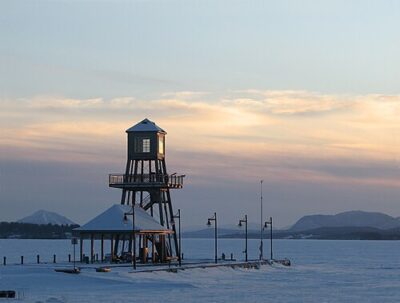
The Barbarian Invasions
The Barbarian Invasions is a 2003 film by Denys Arcand. It stars Marie-Josée Croze, Marina Hands and Dominique Michel. It won the Academy of Canadian Cinema and Television Award for Best Motion Picture and 6 more.
- Released
- May 21, 2003
- Directed by
- Denys Arcand
- Genre
- drama film
- Country of origin
- Canada
All 34 facts, and where they come from
Facts
34 facts · 0 confirmed by two sources · 22 cited · 12 from one source
Where this comes from
Papalocal keeps its own record. It started from these sources; what each one said is kept here as it was copied, so a change on their side never changes this page by itself. Tap one to read its version.
What Wikidata says · copied November 17, 2026 · revision 2563074788
- Described as
- 2003 film by Denys Arcand
- Other names
- Barbarian Invasions
- What it is
- film
- Directed by
- Denys Arcand · 2 references
- Music by
- Pierre Aviat
- Screenplay by
- Denys Arcand
- Produced by
- Denise Robert · 1 reference; Daniel Louis · 1 reference; Fabienne Vonier · 1 reference
- Starring
- Marie-Josée Croze · 1 reference; Marina Hands · 1 reference; Dominique Michel · 1 reference; Rémy Girard · 1 reference; Stéphane Rousseau · 1 reference; Dorothée Berryman · 1 reference; Louise Portal · 1 reference; Daniel Brière; Denis Bouchard · 1 reference; Micheline Lanctôt · 1 reference
- Genre
- drama film; comedy film
- Released
- May 21, 2003 · 1 reference; June 26, 2003 · 1 reference; August 17, 2003 · 1 reference
- Original language
- English; French · 1 reference
- Country of origin
- Canada · 3 references; France · 1 reference
- Comes after
- The Decline of the American Empire
- Followed by
- Days of Darkness
- Awards
- Academy of Canadian Cinema and Television Award for Best Motion Picture (2004) · 1 reference; Academy Award for Best International Feature Film (2004) · 1 reference; European Film Award for Best Non-European Film (2003) · 1 reference; César Award for Best Film (2004) · 1 reference; César Award for Best Director (2004) · 1 reference; César Award for Best Original Screenplay or Adaptation (2004) · 1 reference; Toronto International Film Festival Award for Best Canadian Film (2003) · 1 reference
- Official website
- https://www.miramax.com/movie/the-barbarian-invasions-les-invasions-barbares/
- Wikipedias with a page
- 35
Wikidata item Q549012 (wikidata.org/wiki/Q549012), public domain (CC0). Copied 2026-11-17.
What Wikipedia says · copied November 17, 2026 · revision 1381503207
The Barbarian Invasions (French: Les Invasions barbares) is a 2003 sex comedy-drama film written and directed by Denys Arcand and starring Rémy Girard, Stéphane Rousseau and Marie-Josée Croze. The film is a sequel to Arcand's 1986 film The Decline of the American Empire, continuing the story of the character Rémy, a womanizing history professor now terminally ill with cancer.
The sequel was a result of Arcand's longtime desire to make a film about a character close to death, also incorporating a response to the September 11 attacks of 2001. It was produced by companies from both Canada and France, and shot mainly in Montreal, also employing a former hospital and property near Lake Memphremagog.
The film received a positive response from critics and became one of Arcand's biggest financial successes. It was the first Canadian film to win the Academy Award for Best Foreign Language Film, at the 76th Academy Awards in 2004. It won awards at the 2003 Cannes Film Festival, six Genie Awards, including Best Motion Picture, and three César Awards, including Best Film. The Barbarian Invasions was followed by the thematically related Days of Darkness in 2007 and The Fall of the American Empire in 2018.
From the Wikipedia article “The Barbarian Invasions” (en.wikipedia.org/wiki/The_Barbarian_Invasions), by its contributors, under CC BY-SA 4.0 (creativecommons.org/licenses/by-sa/4.0/). Copied 2026-11-17; not changed.
Confirmed Two sources agree. Cited One source, and it names where it got it. One source One source, without a reference of its own. Sources disagree The sources disagree. We show the best-supported value and keep theirs below.
Picture: Mourial, via Wikimedia Commons · CC BY-SA 3.0