The Book of Five Rings
The Book of Five Rings is a text on kenjutsu and the martial arts, written by Miyamoto Musashi. It came out in 1642.
- Published
- 1642
- Written by
- Miyamoto Musashi
- Genre
- list of Chinese military texts
- Country of origin
- Japan
All 7 facts, and where they come from
Facts
7 facts · 0 confirmed by two sources · 0 cited · 7 from one source
Where this comes from
Papalocal keeps its own record. It started from these sources; what each one said is kept here as it was copied, so a change on their side never changes this page by itself. Tap one to read its version.
What Wikidata says · copied November 17, 2026 · revision 2549975609
- Described as
- text on kenjutsu and the martial arts, written by Miyamoto Musashi
- Other names
- Gorin no Sho
- What it is
- literary work
- Written by
- Miyamoto Musashi
- Genre
- list of Chinese military texts
- Published
- 1642
- Language
- Classical Japanese
- Country of origin
- Japan
- Named after
- five elements
- Wikipedias with a page
- 31
Wikidata item Q572180 (wikidata.org/wiki/Q572180), public domain (CC0). Copied 2026-11-17.
What Wikipedia says · copied November 17, 2026 · revision 1384223410
The Book of Five Rings (五輪書, Go Rin no Sho) is a text on kenjutsu and martial arts in general, written by the Japanese swordsman Miyamoto Musashi between 1643 and 1645. The book title is from the godai (五大) of Buddhist esotericism (密教), and thus has five volumes: "Earth, Water, Fire, Wind, Sky." Many translations have been made, and it has garnered broad attention in East Asia and throughout the world. For instance, some business leaders find its discussion of conflict to be relevant to their work. The modern-day Hyōhō Niten Ichi-ryū employs it as a manual of technique and philosophy.
Musashi establishes a "no-nonsense" theme throughout the text. For instance, he repeatedly remarks that technical flourishes are excessive, and contrasts worrying about such things with the principle that all technique is simply a method of cutting down one's opponent. He also continually makes the point that the understandings expressed in the book are important for combat on any scale, whether a one-on-one duel or a massive battle. Descriptions of principles are often followed by admonitions to "investigate this thoroughly" through practice rather than trying to learn them by merely reading.
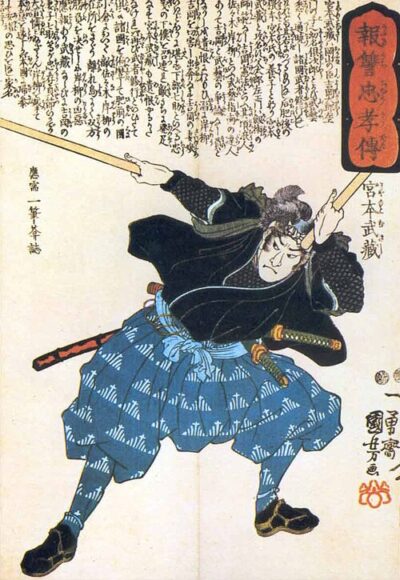
Musashi describes and advocates a two-sword fencing style (nitōjutsu): that is, wielding both katana and wakizashi, contrary to the more traditional method of wielding the katana two-handed. However, he only explicitly describes wielding two swords in a section on fighting against many adversaries. The stories of his many duels rarely refer to Musashi himself wielding two swords, although, since they are mostly oral traditions, their details may be inaccurate. Musashi states within the volume that one should train with a long sword in each hand, thereby training the body and improving one's ability to use two blades simultaneously.
From the Wikipedia article “The Book of Five Rings” (en.wikipedia.org/wiki/The_Book_of_Five_Rings), by its contributors, under CC BY-SA 4.0 (creativecommons.org/licenses/by-sa/4.0/). Copied 2026-11-17; not changed.
Confirmed Two sources agree. Cited One source, and it names where it got it. One source One source, without a reference of its own. Sources disagree The sources disagree. We show the best-supported value and keep theirs below.
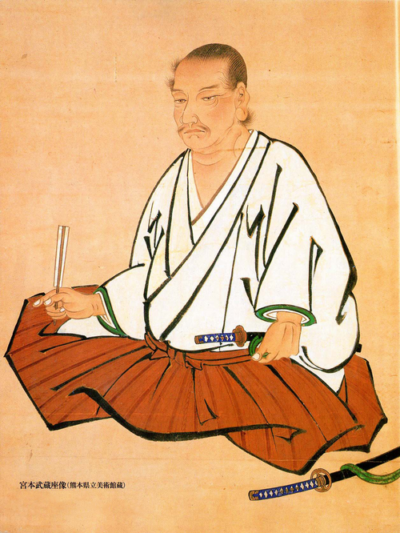
Picture: User Alkivar on en.wikipedia, via Wikimedia Commons · Public domain