The Broken Jug
The Broken Jug is a 1808 German play by Heinrich von Kleist. It came out in 1811.
- Published
- 1811
- Came out
- 1806
- Written by
- Heinrich von Kleist
- Genre
- comedy
All 6 facts, and where they come from
Facts
6 facts · 0 confirmed by two sources · 0 cited · 6 from one source
Where this comes from
Papalocal keeps its own record. It started from these sources; what each one said is kept here as it was copied, so a change on their side never changes this page by itself. Tap one to read its version.
What Wikidata says · copied November 17, 2026 · revision 2555885969
- Described as
- 1808 German play by Heinrich von Kleist
- What it is
- literary work
- Written by
- Heinrich von Kleist
- Genre
- comedy
- Published
- 1811
- Language
- German
- Came out
- 1806
- Wikipedias with a page
- 15
Wikidata item Q486602 (wikidata.org/wiki/Q486602), public domain (CC0). Copied 2026-11-17.
What Wikipedia says · copied November 17, 2026 · revision 1360016112
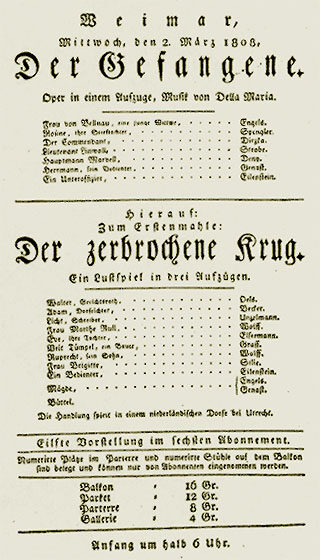
The Broken Jug (German: Der zerbrochne Krug, pronounced [deːɐ̯ t͡sɛɐ̯.ˈbʁɔx.nə kʁuːk] , also sometimes translated The Broken Pitcher) is a comedy written by the German playwright Heinrich von Kleist. Kleist first conceived the idea for the play in 1801 after looking at a copper engraving in Heinrich Zschokke's house entitled "Le juge, ou la cruche cassée". In 1803, challenged over his ability to write comedy, Kleist dictated the first three scenes of the play, though it was not completed until 1806. Johann Wolfgang von Goethe first staged the play in Weimar, where it premiered on 2 March 1808.
The Broken Jug follows the story of a judge who presides over a trial where he has to settle the question of who had broken a jug in the room of a young woman late one night, while himself acting highly suspiciously both before and throughout the whole trial.
From the Wikipedia article “The Broken Jug” (en.wikipedia.org/wiki/The_Broken_Jug), by its contributors, under CC BY-SA 4.0 (creativecommons.org/licenses/by-sa/4.0/). Copied 2026-11-17; not changed.
Confirmed Two sources agree. Cited One source, and it names where it got it. One source One source, without a reference of its own. Sources disagree The sources disagree. We show the best-supported value and keep theirs below.
Picture: printer not known, via Wikimedia Commons · Public domain