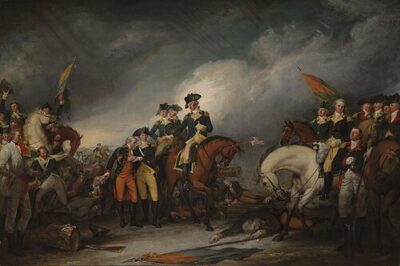
The Capture of the Hessians at Trenton, December 26, 1776
The Capture of the Hessians at Trenton, December 26, 1776 is a painting by John Trumbull. It came out in 1786.
- Came out
- 1786
- Created by
- John Trumbull
- Genre
- history painting
- Country of origin
- United States
All 5 facts, and where they come from
Facts
5 facts · 0 confirmed by two sources · 0 cited · 5 from one source
Where this comes from
Papalocal keeps its own record. It started from these sources; what each one said is kept here as it was copied, so a change on their side never changes this page by itself. Tap one to read its version.
What Wikidata says · copied November 17, 2026 · revision 2268021126
- Described as
- painting by John Trumbull
- What it is
- painting
- Created by
- John Trumbull
- Genre
- history painting
- Country of origin
- United States
- Came out
- 1786
- Wikipedias with a page
- 2
Wikidata item Q28092758 (wikidata.org/wiki/Q28092758), public domain (CC0). Copied 2026-11-17.
What Wikipedia says · copied November 17, 2026 · revision 1371169904
The Capture of the Hessians at Trenton, December 26, 1776 is the title of an oil painting by the American artist John Trumbull depicting the capture of the Hessian soldiers at the Battle of Trenton on the morning of Thursday, December 26, 1776, during the American Revolutionary War. The focus is on General George Washington aiding the mortally wounded Hessian Colonel Johann Gottlieb Rall. Nearly 900 Hessians were captured at the battle. It is one of Trumbull's series of historical paintings on the war, which also includes the Declaration of Independence and The Death of General Mercer at the Battle of Princeton, January 3, 1777. The painting is on view at the Yale University Art Gallery in New Haven, Connecticut.
The artist intended to show the compassion of General George Washington in this painting, as he wrote in the catalogue for his exhibited works at Yale University in 1835:The magnanimous kindness displayed by Washington, on this occasion, offers a sublime example of true heroism, and well deserves to be imitated by all military men. The artist chose this subject, and composed the picture, for the express purpose of giving a lesson to all living and future soldiers in the service of his country, to show mercy and kindness to a fallen enemy,–their enemy no longer when wounded and in their power.
From the Wikipedia article “The Capture of the Hessians at Trenton, December 26, 1776” (en.wikipedia.org/wiki/The_Capture_of_the_Hessians_at_Trenton,_December_26,_1776), by its contributors, under CC BY-SA 4.0 (creativecommons.org/licenses/by-sa/4.0/). Copied 2026-11-17; not changed.
Confirmed Two sources agree. Cited One source, and it names where it got it. One source One source, without a reference of its own. Sources disagree The sources disagree. We show the best-supported value and keep theirs below.
Picture: John Trumbull, via Wikimedia Commons · Public domain