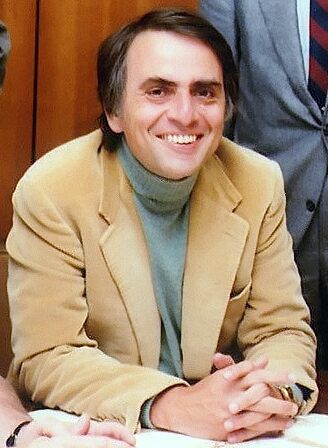
The Demon-Haunted World
The Demon-Haunted World is a 1995 essay by Carl Sagan.
- Published
- 1995
- Written by
- Carl Sagan
- Genre
- popular science literature
- Country of origin
- United States
All 11 facts, and where they come from
Facts
11 facts · 0 confirmed by two sources · 0 cited · 11 from one source
Where this comes from
Papalocal keeps its own record. It started from these sources; what each one said is kept here as it was copied, so a change on their side never changes this page by itself. Tap one to read its version.
What Wikidata says · copied November 16, 2026 · revision 2562205971
- Described as
- 1995 essay by Carl Sagan
- Other names
- The Demon-Haunted World: Science as a Candle in the Dark
- What it is
- literary work
- Written by
- Carl Sagan
- Publisher
- Random House; Ballantine Books
- Genre
- popular science literature; essay
- Published
- 1995
- Language
- English
- Country of origin
- United States
- Comes after
- Pale Blue Dot
- Followed by
- Billions and Billions: Thoughts on Life and Death at the Brink of the Millennium
- Wikipedias with a page
- 19
Wikidata item Q2482106 (wikidata.org/wiki/Q2482106), public domain (CC0). Copied 2026-11-16.
What Wikipedia says · copied November 16, 2026 · revision 1385651491
The Demon-Haunted World: Science as a Candle in the Dark is a 1995 book by the astronomer and science communicator Carl Sagan. (Four of the 25 chapters were written with Ann Druyan.) In it, Sagan aims to explain the scientific method to laypeople and to encourage people to learn critical and skeptical thinking. He explains methods to help distinguish between ideas that are considered valid science and those that can be considered pseudoscience. Sagan states that when new ideas are offered for consideration, they should be tested by means of skeptical thinking and should stand up to rigorous questioning.
From the Wikipedia article “The Demon-Haunted World” (en.wikipedia.org/wiki/The_Demon-Haunted_World), by its contributors, under CC BY-SA 4.0 (creativecommons.org/licenses/by-sa/4.0/). Copied 2026-11-16; not changed.
Confirmed Two sources agree. Cited One source, and it names where it got it. One source One source, without a reference of its own. Sources disagree The sources disagree. We show the best-supported value and keep theirs below.