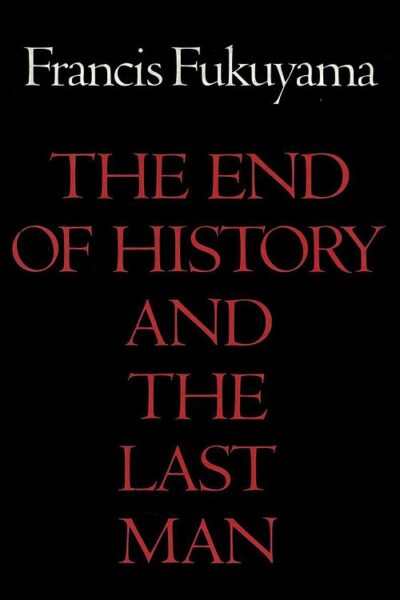
The End of History and the Last Man
The End of History and the Last Man is a 1992 non-fiction work by Francis Fukuyama.
- Published
- 1992
- Came out
- 1990
- Written by
- Francis Fukuyama
- Genre
- fiction
- Country of origin
- United States
All 8 facts, and where they come from
Facts
8 facts · 0 confirmed by two sources · 0 cited · 8 from one source
Where this comes from
Papalocal keeps its own record. It started from these sources; what each one said is kept here as it was copied, so a change on their side never changes this page by itself. Tap one to read its version.
What Wikidata says · copied November 16, 2026 · revision 2564813279
- Described as
- 1992 non-fiction work by Francis Fukuyama
- Other names
- End of History and the Last Man
- What it is
- literary work
- Written by
- Francis Fukuyama
- Publisher
- Free Press
- Genre
- fiction
- Published
- 1992 · 1 reference
- Language
- English
- Country of origin
- United States
- Came out
- 1990
- Wikipedias with a page
- 28
Wikidata item Q1340341 (wikidata.org/wiki/Q1340341), public domain (CC0). Copied 2026-11-16.
What Wikipedia says · copied November 16, 2026 · revision 1384222733
The End of History and the Last Man is a book of political philosophy written in 1992 by American political scientist Francis Fukuyama, which argues that with the ascendancy of Western liberal democracy which occurred after the Cold War (1947–1991) and dissolution of the Soviet Union (1991), humanity has reached "not just [...] the passing of a particular period of post-war history, but the "end of history" as such: That is, the end-point of mankind's ideological evolution and the universalization of Western liberal democracy as the final form of human government." The book expands on Fukuyama's essay "The End of History?", published in the Summer 1989 issue of The National Interest journal.
Fukuyama draws upon the philosophies and ideologies of G. W. F. Hegel and Karl Marx, who explain human history as a dialectical progression from one socioeconomic epoch to another. It has been criticized by political scientists and philosophers on the left and right as oversimplifying the political state of the world. Fukuyama has acknowledged that the book did not anticipate subsequent democratic backsliding from liberal democracies into authoritarianism, but also states that the book's central thesis is commonly misunderstood.
From the Wikipedia article “The End of History and the Last Man” (en.wikipedia.org/wiki/The_End_of_History_and_the_Last_Man), by its contributors, under CC BY-SA 4.0 (creativecommons.org/licenses/by-sa/4.0/). Copied 2026-11-16; not changed.
Confirmed Two sources agree. Cited One source, and it names where it got it. One source One source, without a reference of its own. Sources disagree The sources disagree. We show the best-supported value and keep theirs below.
Picture: Unknown author, via Wikimedia Commons · Public domain