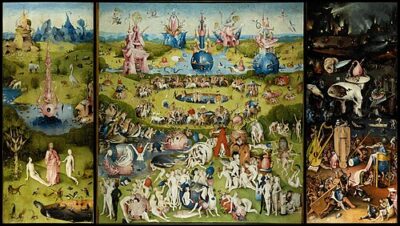
The Garden of Earthly Delights
The Garden of Earthly Delights is a medieval triptych by Hieronymus Bosch, Prado.
- Came out
- 15th century
- Created by
- Hieronymus Bosch
- Genre
- religious art
- Country of origin
- Netherlands
All 9 facts, and where they come from
Facts
9 facts · 0 confirmed by two sources · 5 cited · 4 from one source
Where this comes from
Papalocal keeps its own record. It started from these sources; what each one said is kept here as it was copied, so a change on their side never changes this page by itself. Tap one to read its version.
What Wikidata says · copied November 17, 2026 · revision 2568525765
- Described as
- medieval triptych by Hieronymus Bosch, Prado
- What it is
- painting · 1 reference; triptych
- Created by
- Hieronymus Bosch · 1 reference
- Genre
- religious art
- Country of origin
- Netherlands
- Came out
- 15th century · 1 reference
- Country
- Spain · 1 reference
- Owned by
- Henry III of Nassau-Breda (1517–) · 1 reference; René of Chalon (1538–) · 1 reference
- Wikipedias with a page
- 49
Wikidata item Q321303 (wikidata.org/wiki/Q321303), public domain (CC0). Copied 2026-11-17.
What Wikipedia says · copied November 17, 2026 · revision 1382807143
The Garden of Earthly Delights (Dutch: De tuin der lusten, lit. 'The garden of lusts') is the modern title given to a five-panel triptych (three oil-painted panels when open, two oak panels when closed) painted by the Early Netherlandish master Hieronymus Bosch, painted between 1490 and 1510, when Bosch was between 40 and 60 years old. Because of Bosch's religious beliefs, interpretations of the work typically assume it is a warning against the perils of temptation. The outer panels place the work on the Third Day of Creation. The intricacy of its symbolism, particularly that of the central panel, has led to a wide range of scholarly interpretations over the centuries.
Twentieth-century art historians are divided as to whether the triptych's central panel is a moral warning or a panorama of the paradise lost. He painted three large triptychs (the others are The Last Judgment of c. 1482 and The Haywain Triptych of c. 1516) that can be read from left to right and in which each panel was essential to the meaning of the whole. Each of these three works presents distinct yet linked themes addressing history and faith. Triptychs from this period were generally intended to be read sequentially, the left and right panels often portraying Eden and the Last Judgment respectively, while the main subject was contained in the centerpiece.
It is not known whether The Garden was intended as an altarpiece, but the general view is that the extreme subject matter of the inner center and right panels make it unlikely that it was planned for a church or monastery. It has been housed in the Museo del Prado in Madrid, Spain since 1939.
From the Wikipedia article “The Garden of Earthly Delights” (en.wikipedia.org/wiki/The_Garden_of_Earthly_Delights), by its contributors, under CC BY-SA 4.0 (creativecommons.org/licenses/by-sa/4.0/). Copied 2026-11-17; not changed.
Confirmed Two sources agree. Cited One source, and it names where it got it. One source One source, without a reference of its own. Sources disagree The sources disagree. We show the best-supported value and keep theirs below.
Picture: Hieronymus Bosch, via Wikimedia Commons · Public domain