The Great Wave off Kanagawa
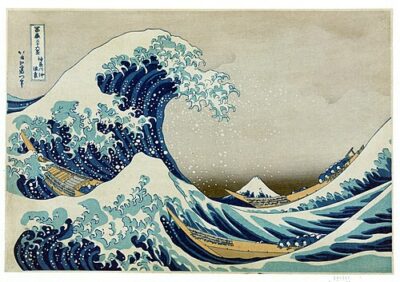
The Great Wave off Kanagawa is a woodblock print by Hokusai. It was created by Katsushika Hokusai. It is part of Thirty-six Views of Mount Fuji.
- Came out
- 1830s
- Created by
- Katsushika Hokusai
- Genre
- ukiyo-e
All 7 facts, and where they come from
Facts
7 facts · 0 confirmed by two sources · 4 cited · 3 from one source
Where this comes from
Papalocal keeps its own record. It started from these sources; what each one said is kept here as it was copied, so a change on their side never changes this page by itself. Tap one to read its version.
What Wikidata says · copied November 17, 2026 · revision 2568521427
- Described as
- woodblock print by Hokusai
- Other names
- Kanagawa-oki nami-ura, Kanagawa oki nami ura, La gran ola, de la serie 20293 seis vistas del monte Fuji, Under the Wave off Kanagawa, Thirty-Six Views of Mount Fuji- The Great Wave Off the Coast of Kanagawa, The Great Wave, from the series Thirty-six Views of Mount Fuji, The Great Wave, Great Wave off the Coast of Kanagawa, Thirty-Six Views of Mt. Fuji – No. 1: The Great Wave off Kanagawa, The Great Wave of Kanagawa, Great Wave off Kanagawa, Great Wave
- What it is
- woodblock print · 2 references
- Created by
- Katsushika Hokusai · 1 reference
- Genre
- ukiyo-e; meisho-e; nishiki-e
- Part of the series
- Thirty-six Views of Mount Fuji · 1 reference
- Came out
- 1830s · 1 reference
- Wikipedias with a page
- 63
Wikidata item Q252485 (wikidata.org/wiki/Q252485), public domain (CC0). Copied 2026-11-17.
What Wikipedia says · copied November 17, 2026 · revision 1384133786
The Great Wave off Kanagawa (Japanese: 神奈川沖浪裏, Hepburn: Kanagawa-oki Nami Ura; lit. 'Under the Wave off Kanagawa') is a woodblock print by the Japanese ukiyo-e artist Hokusai (1760–1849), created in late 1831 during the Edo period of Japanese history. The print depicts three boats moving through a storm-tossed sea, with a large, cresting wave forming a spiral in the centre over the boats and Mount Fuji in the background.
The print is Hokusai's best-known work and the first in his series Thirty-six Views of Mount Fuji, in which the use of Prussian blue revolutionised Japanese prints. The composition of The Great Wave is a synthesis of traditional Japanese prints and use of graphical perspective developed in Europe, and earned him immediate success in Japan and later in Europe, where Hokusai's art inspired works by the Impressionists. Several museums throughout the world hold copies of The Great Wave, many of which came from 19th-century private collections of Japanese prints. Only about 100 prints, in varying conditions, are thought to have survived into the 21st century.
The Great Wave off Kanagawa has been described as "possibly the most reproduced image in the history of all art", as well as being a contender for the "most famous artwork in Japanese history". This woodblock print has influenced several Western artists and musicians, including Claude Debussy, Vincent van Gogh and Claude Monet. Hokusai's younger colleagues Hiroshige and Utagawa Kuniyoshi were inspired to make their own wave-centric works.
From the Wikipedia article “The Great Wave off Kanagawa” (en.wikipedia.org/wiki/The_Great_Wave_off_Kanagawa), by its contributors, under CC BY-SA 4.0 (creativecommons.org/licenses/by-sa/4.0/). Copied 2026-11-17; not changed.
Confirmed Two sources agree. Cited One source, and it names where it got it. One source One source, without a reference of its own. Sources disagree The sources disagree. We show the best-supported value and keep theirs below.
Picture: Katsushika, Hokusai, 1760-1849, artist, via Wikimedia Commons · Public domain