The Haywain Triptych
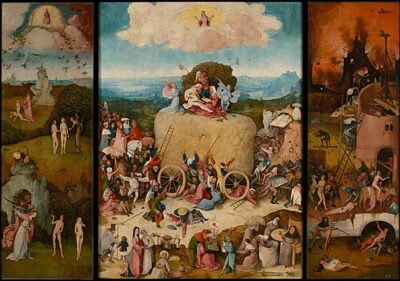
The Haywain Triptych is a triptych by Jheronimus Bosch; Prado version. It came out in 1512. It was created by Hieronymus Bosch.
- Came out
- 1510s (1512–1515)
- Created by
- Hieronymus Bosch
- Genre
- religious art
All 7 facts, and where they come from
Facts
7 facts · 0 confirmed by two sources · 3 cited · 4 from one source
Where this comes from
Papalocal keeps its own record. It started from these sources; what each one said is kept here as it was copied, so a change on their side never changes this page by itself. Tap one to read its version.
What Wikidata says · copied November 17, 2026 · revision 2559139444
- Described as
- triptych by Jheronimus Bosch; Prado version
- What it is
- triptych; painting
- Created by
- Hieronymus Bosch · 1 reference
- Genre
- religious art · 1 reference
- Came out
- 1510s (1512–1515) · 1 reference
- Located in
- Centro
- Country
- Spain
- Wikipedias with a page
- 23
Wikidata item Q2213811 (wikidata.org/wiki/Q2213811), public domain (CC0). Copied 2026-11-17.
What Wikipedia says · copied November 17, 2026 · revision 1381151454
The Haywain Triptych is a panel painting by the Early Netherlandish painter Hieronymus Bosch, now in the Museo del Prado, Madrid, Spain. A date of around 1516 has been established by means of dendrochronological research. The central panel, signed "Jheronimus Bosch", measures 135 cm × 200 cm (53 in × 79 in) and the wings measure 147 cm × 66 cm (58 in × 26 in). The outside shutters feature a full color version of Bosch's The Wayfarer.
From the Wikipedia article “The Haywain Triptych” (en.wikipedia.org/wiki/The_Haywain_Triptych), by its contributors, under CC BY-SA 4.0 (creativecommons.org/licenses/by-sa/4.0/). Copied 2026-11-17; not changed.
Confirmed Two sources agree. Cited One source, and it names where it got it. One source One source, without a reference of its own. Sources disagree The sources disagree. We show the best-supported value and keep theirs below.
Picture: Hieronymus Bosch, via Wikimedia Commons · Public domain