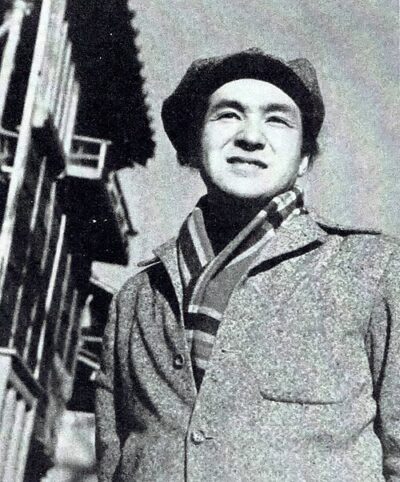
The Human Condition
The Human Condition is a 1959–1961 trilogy of films by Masaki Kobayashi. It stars Tatsuya Nakadai, Michiyo Aratama and Keiji Sada.
- Released
- January 15, 1959
- Directed by
- Masaki Kobayashi
- Genre
- war film
- Country of origin
- Japan
All 18 facts, and where they come from
Facts
18 facts · 0 confirmed by two sources · 7 cited · 11 from one source
Where this comes from
Papalocal keeps its own record. It started from these sources; what each one said is kept here as it was copied, so a change on their side never changes this page by itself. Tap one to read its version.
What Wikidata says · copied November 17, 2026 · revision 2569592375
- Described as
- 1959–1961 trilogy of films by Masaki Kobayashi
- Other names
- Human Condition
- What it is
- film series
- Directed by
- Masaki Kobayashi · 1 reference
- Produced by
- Masaki Kobayashi
- Starring
- Tatsuya Nakadai · 1 reference; Michiyo Aratama · 1 reference; Keiji Sada · 1 reference; Chikage Awashima · 1 reference; Ineko Arima · 1 reference; Sō Yamamura; Kei Satō; Kunie Tanaka; Tamao Nakamura; Chishū Ryū
- Genre
- war film
- Released
- January 15, 1959 · 2 references; December 14, 1959 · 1 reference
- Original language
- Japanese
- Country of origin
- Japan
- Based on
- The Human Condition
- Wikipedias with a page
- 14
Wikidata item Q808114 (wikidata.org/wiki/Q808114), public domain (CC0). Copied 2026-11-17.
What Wikipedia says · copied November 17, 2026 · revision 1385108773
The Human Condition (Japanese: 人間の條件, Hepburn: Ningen no Jōken) is a trilogy of Japanese epic war drama films co-written and directed by Masaki Kobayashi, based on the novel of the same name by Junpei Gomikawa. The films are subtitled No Greater Love (1959), Road to Eternity (1959), and A Soldier's Prayer (1961).
Starring Tatsuya Nakadai in his first major leading role as Japanese pacifist and socialist Kaji, the trilogy follows his journey through the totalitarian and oppressive world of World War II-era Japan and Manchukuo. Kaji begins as a labor camp supervisor seeking to implement more humane treatment of Chinese prisoners, is later conscripted into the Imperial Japanese Army, and ultimately becomes a prisoner of war. Constantly trying to uphold his ideals in a corrupt system, he repeatedly finds his morals an impediment rather than an advantage. Michiyo Aratama co-stars as his wife, Michiko.
Shot back-to-back, the trilogy was a massive undertaking with a then-staggering budget of over ¥300 million. It took approximately three years to produce and involved over 20,000 actors. Each film is divided into two parts, with the trilogy having six parts altogether and a combined running time of 579 minutes (approximately 9 hours and 39 minutes), making it one of the longest narrative films ever made.
Released by Shochiku between 1959 and 1961, the trilogy was controversial in Japan at the time for its critical portrayal of Japanese militarism and wartime conduct, yet it received critical acclaim, won several international awards (including prizes at the Venice Film Festival), and established Kobayashi as one of the most important Japanese directors of his generation. It has since been widely regarded as a monumental anti-war epic and a landmark of Japanese and world cinema.
From the Wikipedia article “The Human Condition (film series)” (en.wikipedia.org/wiki/The_Human_Condition_(film_series)), by its contributors, under CC BY-SA 4.0 (creativecommons.org/licenses/by-sa/4.0/). Copied 2026-11-17; not changed.
Confirmed Two sources agree. Cited One source, and it names where it got it. One source One source, without a reference of its own. Sources disagree The sources disagree. We show the best-supported value and keep theirs below.
Picture: Wikimedia Commons: Ningen no jōken 1.jpg · See Commons file page