The Legend of Sleepy Hollow
The Legend of Sleepy Hollow is a 1820 short story by Washington Irving. It came out in 1819.
- Came out
- 1819
- Written by
- Washington Irving
- Genre
- Gothic literature
- Country of origin
- United States
All 7 facts, and where they come from
Facts
7 facts · 0 confirmed by two sources · 1 cited · 6 from one source
Where this comes from
Papalocal keeps its own record. It started from these sources; what each one said is kept here as it was copied, so a change on their side never changes this page by itself. Tap one to read its version.
What Wikidata says · copied November 16, 2026 · revision 2569931777
- Described as
- 1820 short story by Washington Irving
- What it is
- literary work
- Written by
- Washington Irving · 1 reference
- Genre
- Gothic literature; ghost story
- Language
- English
- Country of origin
- United States
- Came out
- 1819
- Wikipedias with a page
- 35
Wikidata item Q72309 (wikidata.org/wiki/Q72309), public domain (CC0). Copied 2026-11-16.
What Wikipedia says · copied November 16, 2026 · revision 1384424733
The Legend of Sleepy Hollow is an 1820 short story by American author Washington Irving contained in his collection of 34 essays and short stories titled The Sketch Book of Geoffrey Crayon, Gent. Irving wrote the story while living in Birmingham, England.
The Legend of Sleepy Hollow is among the earliest examples of American fiction with enduring appeal along with Rip Van Winkle. Irving's early literary success with The Sketch Book established his career, providing the financial means to support himself and his family as a professional writer. The Legend has remained continuously in print since its initial publication and is one of Irving's most popular works.
It has been adapted for the screen several times, including a 1922 silent film and a 1949 Walt Disney animation as one of two segments in the package film The Adventures of Ichabod and Mr. Toad.
From the Wikipedia article “The Legend of Sleepy Hollow” (en.wikipedia.org/wiki/The_Legend_of_Sleepy_Hollow), by its contributors, under CC BY-SA 4.0 (creativecommons.org/licenses/by-sa/4.0/). Copied 2026-11-16; not changed.
Confirmed Two sources agree. Cited One source, and it names where it got it. One source One source, without a reference of its own. Sources disagree The sources disagree. We show the best-supported value and keep theirs below.
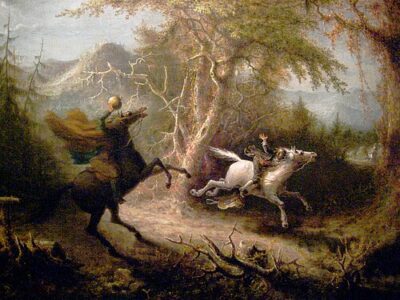
Picture: John Quidor, via Wikimedia Commons · Public domain