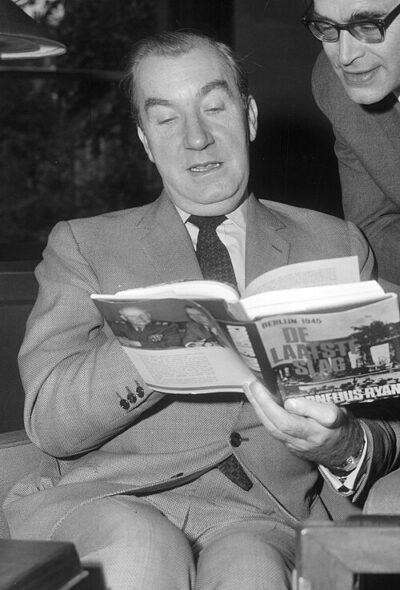
The Longest Day
The Longest Day is a 1959 historical non-fiction work by Cornelius Ryan. It won the Bancarella Literary Prize.
- Published
- 1959
- Came out
- 1959
- Written by
- Cornelius Ryan
- Genre
- reportage
- Country of origin
- United States
All 10 facts, and where they come from
Facts
10 facts · 0 confirmed by two sources · 0 cited · 10 from one source
Where this comes from
Papalocal keeps its own record. It started from these sources; what each one said is kept here as it was copied, so a change on their side never changes this page by itself. Tap one to read its version.
What Wikidata says · copied November 17, 2026 · revision 2513485703
- Described as
- 1959 historical non-fiction work by Cornelius Ryan
- Other names
- The longest day: June 6, 1944.
- What it is
- literary work
- Written by
- Cornelius Ryan
- Publisher
- Simon & Schuster
- Genre
- reportage; historical non-fiction work
- Published
- 1959
- Language
- English
- Country of origin
- United States
- Came out
- 1959
- Awards
- Bancarella Literary Prize (1962) · 1 reference
- Wikipedias with a page
- 12
Wikidata item Q3410561 (wikidata.org/wiki/Q3410561), public domain (CC0). Copied 2026-11-17.
What Wikipedia says · copied November 17, 2026 · revision 1385484866
The Longest Day is a 1959 book by Cornelius Ryan telling the story of D-Day, the first day of the World War II invasion of Normandy. It details the coup de main operation by gliderborne troops, which captured the Caen canal and Orne river bridges (Pegasus Bridge and Horsa Bridge) before the main assault on the Normandy beaches. It sold tens of millions of copies in eighteen different languages. It is based on interviews with a cross-section of participants, including U.S., Canadian, British, French and German officers and civilians.
From the Wikipedia article “The Longest Day (book)” (en.wikipedia.org/wiki/The_Longest_Day_(book)), by its contributors, under CC BY-SA 4.0 (creativecommons.org/licenses/by-sa/4.0/). Copied 2026-11-17; not changed.
Confirmed Two sources agree. Cited One source, and it names where it got it. One source One source, without a reference of its own. Sources disagree The sources disagree. We show the best-supported value and keep theirs below.