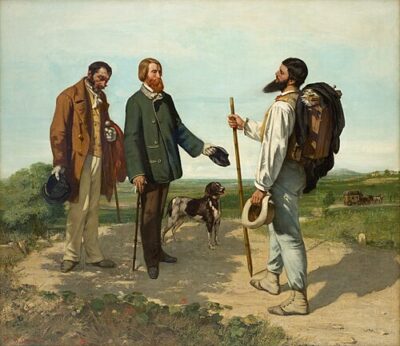
The Meeting, or Bonjour, Monsieur Courbet!
The Meeting, or Bonjour, Monsieur Courbet! is a painting by Gustave Courbet, Musée Fabre. It came out in 1854.
- Came out
- 1854
- Created by
- Gustave Courbet
- Genre
- genre art
All 8 facts, and where they come from
Facts
8 facts · 0 confirmed by two sources · 3 cited · 5 from one source
Where this comes from
Papalocal keeps its own record. It started from these sources; what each one said is kept here as it was copied, so a change on their side never changes this page by itself. Tap one to read its version.
What Wikidata says · copied November 17, 2026 · revision 2569672127
- Described as
- painting by Gustave Courbet, Musée Fabre
- Other names
- The Greeting, Bonjour, Monsieur Courbet
- What it is
- painting
- Created by
- Gustave Courbet · 1 reference
- Genre
- genre art; self-portrait; portrait
- Came out
- 1854 · 1 reference
- Owned by
- Alfred Bruyas (1854–1868) · 1 reference; Musée Fabre (1868–)
- Wikipedias with a page
- 21
Wikidata item Q3642171 (wikidata.org/wiki/Q3642171), public domain (CC0). Copied 2026-11-17.
What Wikipedia says · copied November 17, 2026 · revision 1379869247
The Meeting or "Bonjour, Monsieur Courbet" (French: La rencontre, ou "Bonjour Monsieur Courbet") is an oil-on-canvas painting by Gustave Courbet, made in 1854. It depicts the artist on his way to Montpellier meeting his patron Alfred Bruyas, his servant Calas, and his dog Breton. One of Courbet's most popular works, it also serves as one of the artist's most emblematic contributions to the 19th-century movement of Realism. The composition is based on the myth of the Wandering Jew.
From the Wikipedia article “The Meeting (Courbet)” (en.wikipedia.org/wiki/The_Meeting_(Courbet)), by its contributors, under CC BY-SA 4.0 (creativecommons.org/licenses/by-sa/4.0/). Copied 2026-11-17; not changed.
Confirmed Two sources agree. Cited One source, and it names where it got it. One source One source, without a reference of its own. Sources disagree The sources disagree. We show the best-supported value and keep theirs below.
Picture: Gustave Courbet, via Wikimedia Commons · Public domain